
Kakamega Forest National Reserve | Western Kenya | Kakamega County
Kakamega Forest National Reserve is a place where time stands still. It is the only surviving remnant in Kenya of the ancient Guineo-Congolian tropical rainforest that once stretched across Central Africa. Covering approximately 238 sq km, this primeval jungle offers a “time travel” experience, transporting visitors to a world of thick canopies, thundering waterfalls, and giant trees that have stood for centuries.
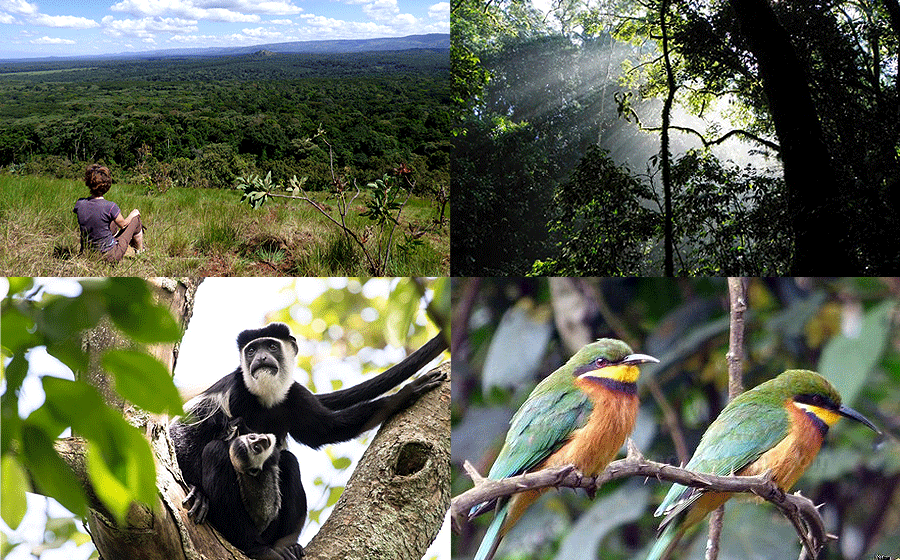
Unlike the open savannahs of the Maasai Mara, a safari here is intimate and immersive. The silence of the forest is broken only by the chatter of monkeys, the calls of over 300 bird species, and the gurgle of the Yala and Isiukhu Rivers.
Divided into two administrative sectors—the National Reserve (north, managed by KWS) and the Forest Reserve (south, managed by the Kenya Forest Service)—this Important Bird Area (IBA) is a biodiversity hotspot. It is home to rare primates, massive trees, and butterflies found nowhere else in the country, making it a perfect, serene retreat from the hustle of city life.
Location & Accessibility
The forest is located in Western Kenya, straddling Kakamega and Nandi Counties, approximately 418 km northwest of Nairobi and just 50 km north of Kisumu.
By Road:
✓ From Kisumu: A short 1-hour drive (50 km) north. This is the easiest access point for fly-in guests
✓ Gates: The main access points include Buyangu Gate (KWS headquarters in the north) and Isecheno Gate (in the south)
✓ From Nairobi: A scenic drive taking 6 to 8 hours via Nakuru, Eldoret, and Kapsabet to Kakamega town. The reserve is about 15 km from the town
By Air:
✓ Nearest Airports: Kisumu International Airport (50 mins flight from Nairobi) or Eldoret Airport. From Kisumu, guests can take a taxi or shuttle to the forest
Wildlife & Biodiversity
Kakamega Forest is not about the “Big Five” but rather the unique, smaller species typical of West African rainforests.
Primates (The Forest Acrobats)
The forest hosts 7 primate species, making it a premier destination for monkey watching.
✓ Diurnal: Black-and-white Colobus, Red-tailed Monkey, Blue Monkey (Gentle Monkey), Olive Baboon, and Vervet Monkey.
✓ Rare & Endangered: The elusive De Brazza’s Monkey (found in the Kisere sector) and the nocturnal Potto (often spotted during night walks).
Birdwatching (An IBA Paradise)
With over 300 to 400 recorded species, the birdlife here is overwhelming. Many species are West African birds found nowhere else in Kenya.
✓ Best Time: Early morning (6:30 AM) or late afternoon (4:30 PM)
✓ Key Species: Great Blue Turaco, Black-billed Turaco, Grey Parrot, Turner’s Eremomela, Blue-headed Bee-eater, and the African Crowned Eagle
Reptiles & Insects
✓ Snakes: Home to 27–36 species, including the Gaboon Viper, Rhinoceros Viper, Forest Cobra, and Jameson’s Mamba
✓ Butterflies: A world-class destination with over 400 species, including the endemic Mitisella Kakamega and the Forest Mother of Pearl
Note: Snakes are shy and rarely seen, but guides are essential for safety.
Other Mammals: include the Giant Forest Squirrel, Bush Pig, Giant Forest Hog, Civet, Genet, Duikers, and the rare Giant Otter Shrew.
Flora & Landscapes
✓ Ancient Trees: The forest features hardwood giants like Elgon Teak and Red/White Stinkwoods
✓ Waterfalls: The scenic Isiukhu Falls and the flow of the Yala River add to the jungle atmosphere
✓ Mama Mutere: The most famous tree in the reserve, standing 40 meters (131 ft) tall. It is hundreds of years old and holds cultural significance for medicinal bar
Experiences & Activities
Kakamega offers a variety of ways to explore the dense canopy and forest floor.
✓ Butterfly Watching: Best done mid-morning when the sun penetrates the canopy
✓ Cultural Encounters: Spend an evening with the indigenous Luhya People to hear ancient stories, watch traditional dances, and learn about herbal medicines
✓ Sunrise & Sunset Tours: Rangers organize trips to Lirhanda Hill, the highest point in the forest, for spectacular views of the canopy at 5:00 AM or 5:00 PM
✓ Night Walks: A signature experience organized by KWS (2 hours). Using spotlights, visitors can spot nocturnal creatures like Pottos, Bush Babies, Tree Pangolins, and the Hammer-headed Fruit Bat
✓ Hiking & Nature Walks: A network of trails ranges from 1 km to 7 km. Popular routes include the trail to Isiukhu Falls and the climb up Buyangu Hill for panoramic views of the Nandi Escarpment
Climate & Best Time to Visit
Because it is a rainforest, rain is possible year-round, but the forest has distinct wetter and drier periods.
✓ Climate: fairly constant temperatures of 20°C – 27°C during the day
✓ Wet Season: April and May are the wettest months. Trails can be muddy and slippery, but the forest is at its greenest, and flowers are in bloom
✓ Best Time (Drier Seasons): December to February and June to August. These months offer the best hiking conditions and excellent birdwatching
Kakamega Forest National Reserve Entrance Fees
2026 Kakamega Forest National Reserve Entrance Fees
|
East African Citizen |
Kenyan Resident |
Non-Resident |
African Citizen |
||||
|
Adult |
Child/ |
Adult |
Child/ |
Adult |
Child/ |
Adult |
Child/ |
|
500 |
250 |
675 |
350 |
50 |
25 |
20 |
10 |
Notes
* Child refers to persons from three years but below 11 years
* Resident refers to persons of other nationalities residing in Kenya with valid documentation from the Kenyan government
* Daily – Fee paid for a single entry to a national park, national reserve, or sanctuary, and which shall be valid for no longer than twenty-four hours
* Citizen – A native or inhabitant of East African countries (Kenya, Uganda, Tanzania, Rwanda, Burundi, and South Sudan) with valid identification documents or a passport
When Is The Best Visiting Time To Go To Kakamega Forest In Kenya
Kakamega Forest National Reserve can be visited year-round. There is quite heavy rain throughout the year, but December to February are the driest months. June to August is an excellent time for bird watching, as many birds breed and display after the rains of April and May. August and September are the best months for butterflies. Migrant birds are present from November to April.
Worst Weather: April and May (Wettest months)
Best Weather: December to February (Less rainfall)
Best Time: December to February and June to July (Less rain and best bird watching)
Low Season: April to June & November to mid-December (Low-season rates may apply)
High Season: mid-December to March & July to October (The reserve never gets very busy)
Kakamega Forest National Reserve Attractions | Animals | Birds | Snakes | Trees
Kakamega Forest National Reserve attractions and activities include birdwatching, primate tracking, game viewing, walking and hiking trips, river fishing, nature walks, and camping.
Kakamega Forest Bird Watching
Kakamega Forest is one of the last remaining ancient rainforests in Kenya, and its birdlife is outstanding! Many birders consider Kakamega Forest a bird-watcher’s paradise, productive year-round. Unusual forest species are often permanent inhabitants and can be seen at any time. Migratory birds swoop into the forest from November to April.
The forest supports 80 species at the eastern limit of their range from central and West Africa; examples include the spectacular great blue turaco and the colorful blue-headed bee-eater. In the reserve, more than 367 bird species have been recorded, 36 of which are endemic to the forest and found only here.
Migratory birds come in from November to April. Popular Bird species seen on the Kakamega Forest birding tour include Great Blue Turaco, Ross’s Turaco, Crowned Eagle, Black-faced Rufous Warbler, and Chapin’s Flycatcher.
Others include the Yellow-mantled Widowbird, Uganda Woodland Warbler, White-chinned Prinia, Turner’s Eremomela, Green Hylia, Yellow-bellied Hyliota, Vieillot’s Black Weaver, and Olive-Green Camaroptera, African Broadbill, Snowy-headed Robin-Chat, Hairy-breasted Barbet, Green-throated Sunbird, Mackinnon’s Fiscal, and others.
White-spotted Flufftail, Dusky Tit, Luhder’s Bush-Shrike, Black-crowned Waxbill, White-breasted Negrofinch, Yellow-crested Woodpecker, Equatorial Akalat, White-tailed Ant-Thrush, Blue-headed Bee-eater, Common Wattle-eye, Jameson’s Wattle-eye, Black-billed Turaco, and Yellow-bellied Wattle-eye.
Kakamega Forest Wildlife
These are some of the animals you can see on a walk through Kakamega Park. These include buffaloes, Jackson’s hartebeest, bushbucks, Roan antelope, Black-and-white Colobus, red-tailed and blue monkey, Elephant Shrew, Ader’s Duiker, Banded Mongoose, Genet Cat, Bush Baby, olive baboons, vervet monkeys, and the De Brazza’s Monkey, locally referred to as the ‘Karasingi’.
Others include African Civet, Tree Pangolin, Potto, Bush Pig, Giant Forest Hogs, Giant forest squirrels, African Clawless Otter, duiker, Sunni, giraffes, pangolin, porcupine, water squirrels, and dik-dik. You can also spot a wide variety of snakes, including Jameson’s Mamba, Rhinoceros-horned Viper, Black-lipped Cobra, Bush Viper, and more.
Game viewing in the reserve is best during the dry months of December to February, when there is no rain and animals are more visible.
Kakamega Forest Trees Species
The reserve has over 300 tree species, including some of Africa’s greatest hardwoods and softwoods: Elgon teak (Olea welwitschii), red stinkwood (Prunus africana), white stinkwood, several croton varieties, and Pouteria altissima. There are 380 recorded plant species.
This includes 60 species of ferns, 150 species of trees and shrubs, and 170 species of flowering plants, including 60 species of orchids, with 9 species found only in this forest.
Best Time to Visit | Hotels & Lodges | How to Get to Kakamega Forest
Best time to visit Kakamega Forest National Reserve
The reserve can be visited year-round. The periods when it rains less (December to February and June to July) are the best times to come to Kakamega. June to August is an excellent time for bird watching, as many birds breed and display after the rains of April and May.
August and September are the best months for butterflies. And migrant birds are present from November to April.
How to get to Kakamega Forest National Reserve
Kakamega Forest Reserve can be accessed by road or by Air from Nairobi. By road, Kakamega Forest is 420 km (260 mi) northwest of Nairobi and 45 km (27 mi) north of Kisumu. The drive from Nairobi takes about 6 hours. Kisumu International Airport is an hour’s drive away from Kakamega.
By Flight: Charter flights can be arranged for you by tour operators; there are daily flights from Jomo Kenyatta International Airport to Kakamega. Also, there are now scheduled flights to Kakamega and visitors can also fly to Kisumu or Eldoret and travel by road to Kakamega.
Where to stay in Kakamega Forest National Reserve
There are accommodation facilities and camping sites where to stay at Kakamega Forest National Reserve. Choices range from self-catering chalets and lodges to rustic campsites, but whatever accommodation is chosen, the experience is sure to inspire.
Camping in the forest offers so many rewards: a wake-up call from the winged ones, as you enjoy your breakfast, and you cannot stop listening to the beautiful melodies that escape from the forest, colouring your morning. The cool, forest feel enhances your stay here as you enjoy the outdoor camping adventure. If you wish to stay in Kakamega town, there are several accommodation options.
Isecheno KEEP Bandas
Isecheno KEEP bandas are located in the Kakamega rainforest in the southern part of the Isecheno forest station. Keep bandas can accommodate 21 people. There are 5 bandas, banda one has 5 beds, banda two has been partitioned and has 2 rooms each has 2 beds. Banda 3 has also been partitioned and has 4 beds, Banda 4 has 5 beds, and Banda 5 has 3 beds.
In KEEP bandas, there are warm and cold showers outside the room. Here, the lights are powered by generators and lanterns at night. There is a kitchen where guests can cook their own food. The kitchen has utensils, cooking facilities, and tap water. But for those guests who need meals, we offer catering services for either workshops or for tourists visiting the forest.
Senel Guest House
Set just 21 km from Kakamega Forest Station, Senel Guest House offers accommodation in Kakamega with access to a shared lounge, a garden, and a shared kitchen. This property offers access to a balcony and free private parking.
This apartment has 5 bedrooms, a kitchen with a microwave and an oven, a flat-screen TV, a seating area, and 4 bathrooms with showers. For added convenience, the property can provide towels and bed linen for an extra charge. This is one of the main places to stay at Kakamega Forest National Reserve.
Isukuti Guest House
Located in a spectacular haven for nature lovers, with over 300 bird and 400 butterfly species, these facilities offer an intimate experience amid the Kakamega Forest, home to over 300 tree species, mostly indigenous. Park highlights include tropical forest, bird, and butterfly viewing.
One can also view the following Wildlife: diverse species of primates, snakes, birds, and butterflies.
Golf Hotel Kakamega
Golf Hotel Kakamega is located in a plush area of Kakamega town, next to the Golf Course, and is just a short distance from Kakamega Forest, which has over 320 bird species. It takes approximately half an hour to drive from Kisumu Airport to the hotel, and with prior arrangement, the Hotel van is available for a fee.
Rondo Retreat Centre
Rondo Retreat Center is located in the Kakamega rainforest in the Southern part. It is managed by the Trinity Fellowship. Rondo is a Christian center, and alcoholic drinks are not allowed on the premises. Rondo Retreat is a clean, quiet place that can accommodate Missionaries and Tourists visiting the Kakamega Forest.
Rondo can accommodate up to 35 people, but it can serve up to 50 people for lunch or dinner, and it offers a conference facility for small groups. Rondo Retreat Center is one of the best accommodations in the Kakamega rainforest, with beautiful gardens and flowers, relaxing spaces, and high-standard single, double, and triple rooms.
Not found anywhere else. Kakamega is known more for being the home of the Kakamega forest, one of the last remnants of indigenous rainforests in the world, bull-fighting, cock-fighting, and even a dog market- an interesting piece of the cultural tourism that Kenya has to offer.
Kakamega Forest National Reserve Information
Kakamega Forest is a tropical rainforest located in Kakamega and Nandi counties of Kenya, northwest of the capital, Nairobi, and near the border with Uganda. It is Kenya’s only tropical rainforest, covering approximately 240 square km², and is said to be Kenya’s last remnant of the ancient Guineo-Congolian rainforest that stretched across West Africa.
Kakamega Forest Reserve is about twice the size of Nairobi National Park. It is an area of mostly indigenous vegetation that offers unique wildlife and scenic beauty, located about 15km from Kakamega town. The reserve was established to protect only a residue of a unique forest ecosystem. The word “Kakamega” translates roughly to “pinch” in Kiluhyah.
It was most likely used to describe how European colonists ate the staple food, ugali, rather than the traditional method. Ugali is still a popular maize dish in local cuisine, usually rolled into a lump or ball and dipped in the preferred sauce or stew.
Kakamega is accessible year-round, but the best time to visit is during the rainy season, from April to July. Kakamega forest is divided into two separate management schemes. The northern part of the forest (the National Reserve) is managed by the Kenya Wildlife Service, while the southern section (the Forest Reserve) is managed by the Forestry Department.
The KWS entry point is at the North in the Buyangu Area. It is within walking distance of the KWS office, which is approximately 2 km from the main road. The Kenya Forestry Service entry gate is in the South in the Isecheno Area. The forest’s major attractions include birds, insects, butterflies, and other wildlife, all of which are plentiful in the area.
Trees and plants include some of Africa’s greatest hard and soft woods, like the precious Elgon teak, much prized for its hardwood, and red and white stink woods. There are also notorious stranglers (Ficus thoningii) that grow from other trees and eventually strangle the hosts to death. The potent Mkombero tree, a popular aphrodisiac, also grows here.
There are also many species of splendid orchids, a handful of which are endemic, growing among the branches of larger trees. Flora in the park includes over 50 fern species and 170 other flowering plant species. Animals include 7 primate species, such as the endangered De Brazza monkey, which is mostly found in the isolated Kisere Forest Reserve.
Many other rare primate species are common here, such as the Blue monkey, frequently seen near the Ishiuku Falls, the Olive baboon, and the Red-Tailed monkey. Other mammals in the area include the Clawless Otter, Mongoose, Giant Water Shrew, flying squirrels, Bushbucks, Aardvarks, Porcupines, Giant Forest Hog, Leopard, and many more.
Kakamega Forest is home to an estimated 360 bird species, making it a popular destination for bird and butterfly watchers. The Reserve supports a myriad of bird species, including the endangered Turner’s eremomela, Charpin’s flycatcher, and the voice-mimicking African grey parrot, as well as several rare snake-eating birds. In addition, insects are abundant, with some spectacular favorites such as Goliath beetles and Flower Mantises.
Other particularly well-represented groups are ants and Orthopterans. Gastropods, millipedes, and spiders alike are very common, too. In addition, a butterfly farm has been set up for these colorful lepidopterans, comprised of over 400 species of butterflies, about 45% of all recorded butterflies in Kenya.
27 Snake species normally found in West Africa are present in the area, alongside nearly 30 other species. The region is also home to Africa’s largest and most aggressive cobras, known as the Kakamega forest cobra. Other big snakes found in the area include the forest adder, black mamba, and green mamba. Its smaller reptiles include chameleons, skinks, and lizards.
Booking & Reservations Kakamega Forest National Reserve Contact
Mobile: + 254-780-242-711
WhatsApp: +254-721-242-711
Reservations: +254 718-179-967
Email: [email protected]
Website: https://africanspicesafaris.com