
Menengai Crater | ~10 km (6 miles) (15-minute drive) North of Nakuru Town in Kenya | Sits on the floor of the Great Rift Valley | ~ 158 km (3-hour drive) from Nairobi | ~75 km from Naivasha Town
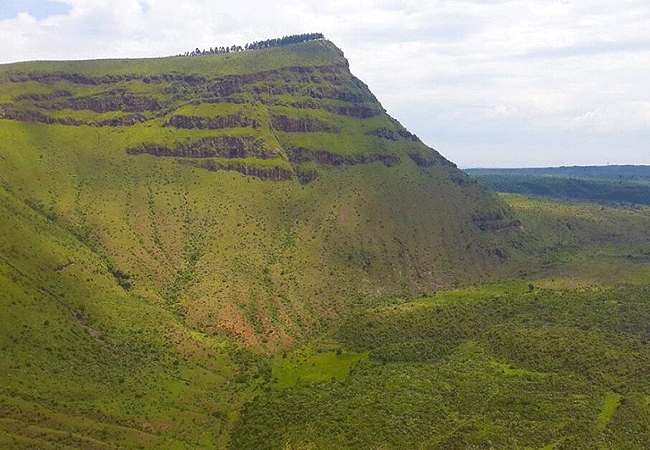
Menengai Crater, an awe-inspiring shield volcano located on the floor of the Great Rift Valley. Covering a massive 90 square kilometers, with a diameter stretching up to 12 kilometers and plunging to a depth of 500 meters from the rim, it is a monument to the Earth’s raw tectonic power.
Standing proudly as Kenya’s second-largest volcanic caldera and Africa’s second-largest, Menengai offers travelers a breathtaking blend of geological grandeur, rich biodiversity, and captivating folklore. Menengai is classified as a massive trachytic shield volcano. For volcanologists and nature lovers alike, it is a masterclass in tectonic history.
Ancient Origins: The mountain itself began forming over 200,000 years ago through continuous, violent eruptions.
The Great Collapse: The magnificent 12×8-kilometer caldera you see today was formed roughly 8,000 years ago. A catastrophic “Krakatau-style” eruption caused the massive underlying magma chamber to completely empty, leading the volcano’s roof to collapse inward. Today, it is recognized globally as one of the best-preserved Krakatau-style calderas.
A Rugged Floor: Unlike many older calderas that have filled with sediment, Menengai’s floor remains highly rugged. It is covered in a thick, dramatic mass of black lava boulders, inaccessible ridges, and over 70 distinct post-caldera lava flows, some of which occurred just a few hundred years ago.
Location & Accessibility
Situated in Nakuru County, the crater is an incredibly accessible day-trip destination, whether you are traveling from Nakuru City or Nairobi.
By Road
✓ From Nairobi: The journey covers approximately 170 to 180 kilometers via the scenic Nairobi-Nakuru Highway (A104) and takes about 2.5 to 3 hours, offering beautiful views of the Rift Valley escarpment along the way.
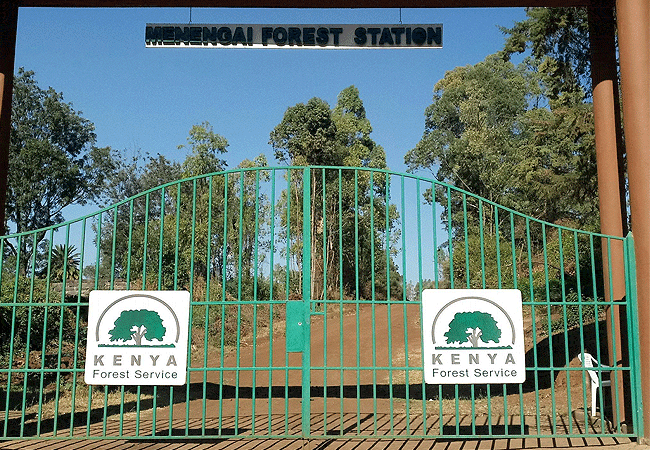
✓ From Nakuru Town: The crater is located just 10 kilometers north of Nakuru’s central business district. From town, it is a short, steady 20 to 30-minute drive uphill to the Menengai Forest Station gate and the main crater viewpoint.
By Air
✓ For a faster, highly scenic alternative, travelers can book a scheduled domestic or private charter flight from Nairobi’s Wilson Airport directly to the Nakuru Airstrip. The flight takes roughly 30 minutes, followed by a quick 10 to 15-minute road transfer directly to the crater entrance.
The History of Menengai Crater
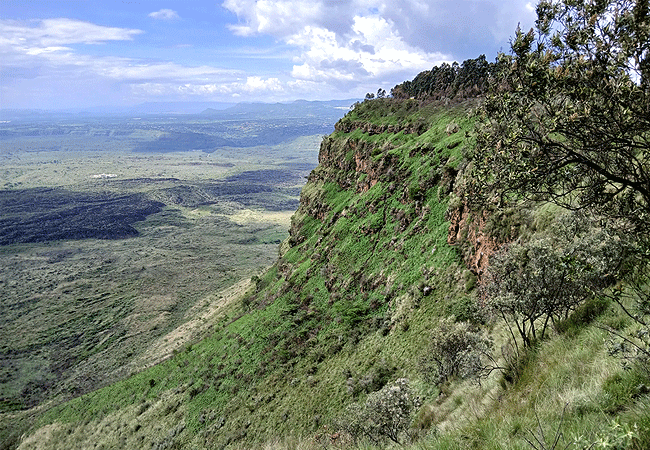
At 2,490 meters (8,169 feet) above sea level, the crater rim provides breathtaking, panoramic views of the Rift Valley, Lake Nakuru, and Lake Bogoria. Yet, beneath this tranquil beauty lies a dark, violent history that has fueled centuries of local myth.
The Battle of the Maasai
During the 19th century, the crater was the site of a brutal and bloody conflict over prized pastureland between two Maasai clans: the Ilpurko and the Ilaikipiak. The traditionalist Ilpurko warriors emerged victorious, mercilessly tossing the defeated Ilaikipiak over the steep, 500-meter caldera edge. Because of this massacre, the crater earned the Maa name Menengai, meaning “The Place of the Dead” or “The Corpse”.
Hauntings & Spirits
Menengai is widely considered a deeply spiritual and highly supernatural place.
✓ A Place of Pilgrimage: Despite the dark legends, many religious pilgrims travel here to fast and pray in the crater’s caves, drawn to the powerful spiritual energy of the site
✓ The Souls of the Vanquished: Local legends insist that the plumes of steam venting from the fumaroles on the caldera floor are actually the souls of the defeated Ilaikipiak warriors desperately trying to reach heaven
✓ Supernatural Phenomena: Folklore warns that the caldera is haunted by evil spirits. Tales speak of people who have wandered into the caldera and vanished without a trace, or returned days later in a state of total confusion
✓ “Devil’s Hill”: The local Kikuyu community has legends of a “Devil’s Hill” (Kirima Kia Goma) within the crater. Eyewitnesses have shared bizarre accounts of ghostly entities cultivating the caldera floor, plowing with tractors, planting wheat, and harvesting it all within a single hour. There are even tales of a flying umbrella rising from the crater floor during rainstorms
The Menengai Caves
Deep within the breathtaking landscape of the Menengai Crater lies a network of sacred lava caves that have fascinated pilgrims, historians, and adventurers for generations. Hidden among the lush forests and rugged volcanic terrain, these caves offer far more than a sightseeing experience; they provide a profound journey into Kenya’s geological wonders, cultural heritage, and spiritual traditions.
A Place of Silence and Reflection
As visitors descend toward the caves, they leave behind the sounds of the modern world and enter an atmosphere of remarkable peace and solitude. The cool air, natural darkness, and quiet surroundings create an environment ideal for reflection, meditation, and personal discovery.
Spiritual Significance
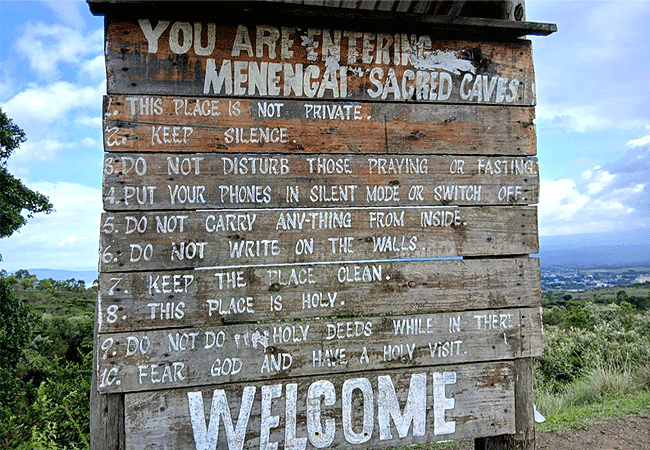
For many years, the caves have served as a destination for prayer, fasting, worship, and spiritual retreat. Visitors from different faiths travel to Menengai seeking tranquility, inspiration, and a deeper connection with nature. Some spend hours in quiet contemplation, while others stay for extended periods to focus on personal growth, renewal, and inner peace.
Cultural Heritage
These caves are deeply connected to local history and oral traditions, serving as ancient gathering places and sacred sites for surrounding communities.
The Mau Mau Hideouts: During Kenya’s struggle for independence from British colonial forces, these deep, hidden caves were famously used as strategic, impenetrable hideouts by Mau Mau freedom fighters.
Geological Wonders & Education
Beyond spirituality and history, the caves serve as a natural classroom for students, researchers, and nature enthusiasts interested in earth sciences. Exploring the caves provides fascinating insights into:
✓ The formation of volcanic caves and lava structures.
✓ The history of Menengai’s violent volcanic eruptions.
✓ The development of one of Africa’s largest calderas.
✓ The relationship between volcanic activity and geothermal energy.
Geothermal Power & The Future
While classified as dormant, the volcano remains highly active beneath the surface. Plumes of steam naturally vent from the ground across the caldera. Recognizing this massive energy potential, the Geothermal Development Company (GDC) has established a massive, multi-phase geothermal power project on the caldera floor. This incredible engineering feat aims to harness up to 1,600 MW of clean, renewable energy to power Kenya’s future.
Biodiversity (Flora & Fauna)
Despite its rugged volcanic terrain, the Menengai Crater is surrounded by a lush, vibrant forest protected by the Kenya Forest Service. It is home to an incredibly diverse ecosystem that thrives in the fertile volcanic loam soils.
The Flora
The ecosystem supports over 169 species of flowering plants and 17 distinct species of grasses.
✓ Grasses: The crater floor uniquely supports a specialized geothermal grass (Fimbristylis exilis) that thrives near the hot steam vents, alongside hardy Boma Rhodes grass
✓ Trees & Shrubs: The steep crater slopes are densely covered in Leleshwa (Tarchonanthus camphoratus), various native Acacia species, and striking, towering Euphorbias
The Fauna
While it is not a traditional “Big Five” open savannah safari park, the Menengai Forest is a sanctuary for a wonderful variety of wildlife.
✓ Insects & Reptiles: The ecosystem is rounded out by a variety of snakes, arachnids, mollusks, and vibrant butterfly species that flutter through the dense forest canopy
✓ Mammals: Hikers can easily spot troops of olive baboons and black-faced vervet monkeys playing along the trails. The forest is also home to Kirk’s dik-diks, mountain reedbucks, tree and rock hyraxes, slender mongooses, small duikers, and the occasional buffalo or spotted hyena
✓ Birdlife: Menengai is an absolute paradise for birdwatchers, boasting over 200 recorded species. Notably, it is the only place in the Nakuru region where you can spot the majestic Verreaux’s eagle. Other notable species include the Abyssinian ground hornbill, African marsh harrier, lesser spotted eagle, Horus swift, fan-tailed raven, Rüppell’s vulture, Fischer’s starling, and the African pied wagtail
Menengai Crater Activities & Tips
Activities & Attractions
Whether you are looking for a grueling physical challenge or a peaceful day of sightseeing, Menengai Crater offers a unique blend of adventure and natural beauty.
✓ Camping & Picnicking: There are designated campsites and picnic spots, allowing visitors to spend the night under the stars in the caldera
✓ Mountain Biking: The Kenya Forest Service maintains a network of driving tracks and walking trails through the lush Menengai Forest that are perfect for mountain biking
✓ Geothermal Viewing: From the rim, you can view the massive Geothermal Development Company (GDC) project, a fascinating look at how Kenya harnesses natural volcanic steam for power
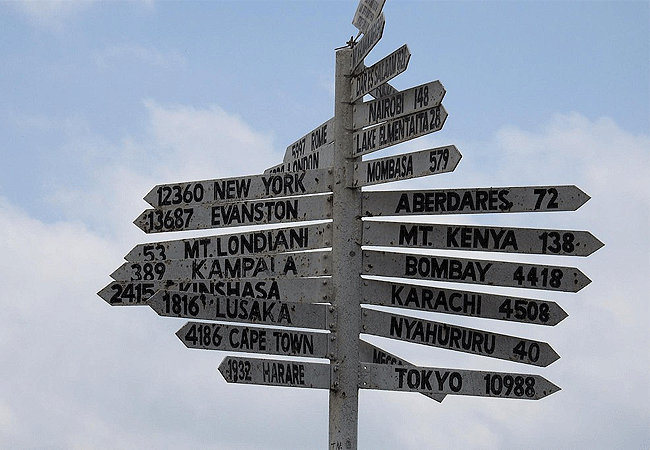
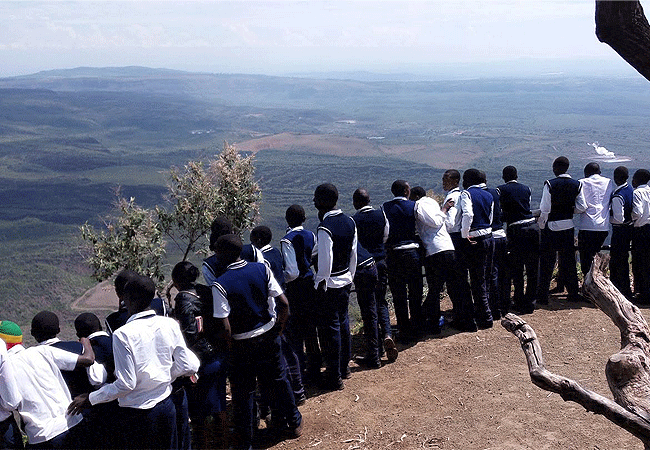
✓ The Viewpoints: If you prefer not to hike the floor, the primary viewpoint on the rim offers jaw-dropping, panoramic vistas of the Great Rift Valley, Lake Nakuru, and on clear days, Lake Bogoria
✓ Birdwatching & Wildlife Photography: With over 200 bird species and resident mammals like baboons and dik-diks, a slow walk along the forested rim provides incredible photography opportunities
✓ Cave Exploration: Hire a local guide to explore the lava-formed Mau Mau caves nestled in the crater cliffs. Because they are actively used for spiritual retreats, visitors are asked to remain respectful of those praying
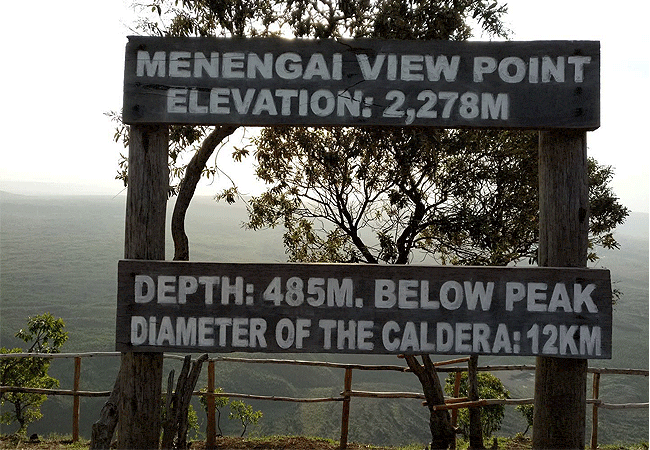
✓ The Caldera Hike: For the adventurous, the main attraction is the trek down to the caldera floor. Starting from the main Viewpoint (at 2,278m), the trail weaves steeply down into the crater. After a short flat section on the floor, the hike out requires a torturous, sharp 500-meter ascent back to the rim. This is a moderately difficult to challenging hike that takes roughly 4 to 7 hours round trip
Travel Tips & Best Time to Visit
To ensure your trip to Menengai Crater is safe and memorable, adequate preparation is essential.
When to Visit
The best time to visit is during the dry seasons: January to February and June to October. During the rainy seasons, the steep dirt trails into the caldera become incredibly slippery and treacherous. Early mornings and late evenings offer the most spectacular lighting for photography and cooler temperatures for hiking.
Visiting Summary
Opening Time: 0600 Hours
Closing Time: 1800 Hours
Days Open: Monday to Sunday (including public holidays)
Best Time to Hike: Arrive between 0800 Hours and 1000 Hours to complete the 4- to 5-hour trek before the afternoon heat peaks
What to Pack
✓ Footwear: Sturdy, high-traction hiking boots are mandatory if you plan to descend into the crater
✓ Hydration & Fuel: Carry at least 2 to 3 liters of drinking water and high-energy snacks. There are no shops once you leave the main gate
✓ Gear: A good camera, a pair of binoculars for birdwatching, and insect repellent. If you plan on exploring the caves, bring a strong flashlight
✓ Sun & Weather Protection: A wide-brimmed hat, sunglasses, and sunscreen. Pack a light jacket, as the crater rim can get very windy and chilly
Logistics & Fees
✓ Entry: The crater is protected by the Kenya Forest Service (KFS). You will need to pay an entry fee at the barrier gate
✓ Guides: While you can explore the main viewpoint on your own, it is highly recommended to hire a local guide at the gate if you plan to hike down to the caldera floor. The lower trails are not always well-marked, and a guide ensures your safety on the steep ascents
Menengai Crater Agriculture & Conservation
Agribusiness & Community Farming
Agribusiness is one of the primary ways the Menengai Community Forest Association (CFA) supports community livelihoods while championing the sustainable use of land and natural resources. For the many households surrounding Menengai that depend on small-scale agriculture, the CFA helps transform basic farming into a thriving, conservation-friendly business.
When farmers are empowered, trained, organized, and supported, they become much stronger partners in protecting the 90-square-kilometer crater ecosystem.
Farming as a Livelihood & Business
Treating farming as a business means generating sustainable income, creating local employment, and strengthening the local economy, rather than simply producing food for survival.
✓ Food Security & Resilience: By growing crops, improving soil health, and planting trees responsibly, families reduce dependency and build long-term sustainability.
✓ Youth & Women Empowerment: Small agricultural enterprises, nurseries, and group farming initiatives provide youth and women with crucial skills, income, confidence, and leadership opportunities that directly benefit their households and the wider community.
Supporting the Community
The CFA provides tailored support to ensure the community benefits from the land without putting unnecessary pressure on the forest.
✓ Individual Farmers: The CFA helps individuals align their farming with conservation through land-use guidance, tree-planting support, and temporary farming opportunities in designated restoration areas. This allows farmers to tend to their crops while simultaneously caring for young trees.
✓ Group Farming Initiatives: The CFA heavily supports women’s groups, youth groups, and conservation-based self-help groups. Group farming allows members to share labor, land, resources, and profits across projects like community food initiatives, demonstration farms, and school-linked agriculture.
Conservation-Linked Enterprises
The CFA promotes practical farming methods that support conservation instead of damaging the environment.
✓ Agroforestry: Farmers are encouraged to plant trees within their farms alongside their regular crops. These trees provide shade, improve soil health, reduce erosion, and supply fodder, increasing the farm’s long-term value
✓ Beekeeping: The CFA educates the community about apiculture, helps establish apiaries, and encourages organized honey production. Because bees depend on healthy vegetation, this directly incentivizes tree planting while also improving local crop pollination
✓ Community Tree Nurseries: Community members raise and care for seedlings. When trees are needed for reafforestation, school greening, or environmental programs, the CFA sources them directly from these local nurseries, creating a reliable, direct income stream for the community
Training, Capacity Building & Market Linkages
Agribusiness cannot grow without knowledge and reliable buyers. The CFA plays a coordinating, guiding role by focusing on:
✓ Education & Training: Providing farmers with critical skills in agribusiness planning, group management, soil and water conservation, value addition, and financial record keeping.
✓ Creating Market Opportunities: Helping farmers move from small-scale production to sustainable income generation by finding reliable markets for their honey, seedlings, and farm produce. The CFA helps communities focus on product quality, consistency, and packaging to attract buyers.
Why Agribusiness Matters to Menengai
Menengai’s future depends entirely on balancing environmental protection with community empowerment. If communities are supported through sustainable, income-generating activities, they are far more likely to protect the forest, participate in conservation efforts, and avoid destructive practices. Through agribusiness, the CFA ensures that agriculture is not a threat to the crater, but an active part of the conservation solution.
Menengai Crater Prices
2026 Menengai Crater Entrance Fees
|
East African Citizen |
Resident |
Non-Resident |
||||
|
Adult |
Child/ |
Adult |
Child/ |
Adult |
Child |
Collage |
|
332 |
100 |
1,000 |
300 |
12 |
4 |
6 |
Notes
✓ Hiking: 7,000 Kenya Shillings for a group of 15
✓ Trekking / Walking: 2,000 Kenya Shillings per month
✓ Educational Tours: 1,000 Kenya Shillings per group/service
✓ Beekeeping Studies: 2,000 Kenya Shillings per group/service
✓ Nature Walks (Forest Walks): 5,000 Kenya Shillings per group
✓ Caves Exploration and Research: 5,000 Kenya Shillings per group/service
✓ Geothermal Exploration (Geo-tourism): 3,000 Kenya Shillings per group/service
✓ Educational Tour to Fault Lines and Caves: 2,000 Kenya Shillings per group/service
Vehicle Entry Fees
✓ 4×4 Car (5 seater): 200 Kenya Shillings
✓ Minivan (14 seater): 500 Kenya Shillings
✓ Bus (Above 14 seater): 1,000 Kenya Shillings
Note
✓ Fees must be paid digitally via M-Pesa at the main entry gate; cash and credit cards are typically not accepted. Make sure to carry your National ID or Passport for registration
Menengai Crater Tours
Menengai Crater Nakuru 1 Day Hiking Tour from Nairobi – Kenya
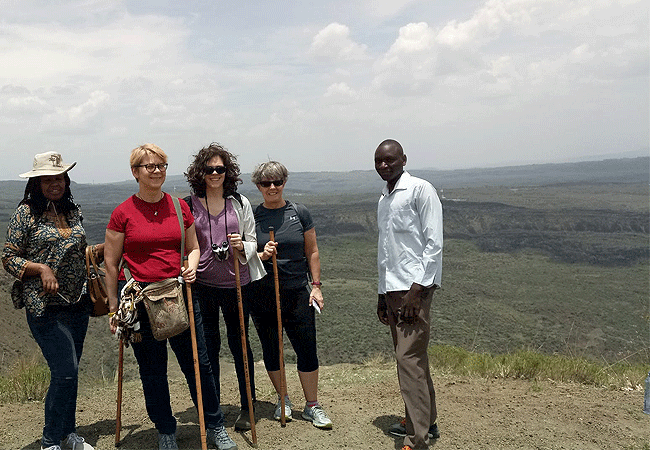
Menengai Crater Nakuru 1 day hiking tour is a full day trip to climb Menengai crater located about 180 km's from Nairobi. The crater is located 10 km's (6 miles) north of Nakuru, the fourth-biggest city in Kenya. The drive from Nairobi to Nakuru takes about 3 Hours. A further 10 minutes drive from Nakuru town brings you to the foot of the crater where the Menengai Forest station offices are located. The walking starts and ends at Menegai Crater view point and takes about 4 hours.
Booking & Reservations Menengai Crater Contact
Mobile: + 254-721-242-711
WhatsApp: +254-721-242-711
Reservations: +254 718-179-967
Email: [email protected]
Website: https://africanspicesafaris.com