
Mombasa City Tours 1 Day Fort Jesus Jumba Ruins Trip
This is a popular guided day tour that explores 2 historical sites of Mombasa:
✓ Jumba la Mtwana Ruins
✓ Fort Jesus National Museum
0800 Hours: Our 1-Day Mombasa historical sites adventure starts with collection from your hotel in Mombasa. We visit Fort Jesus Museum, a Portuguese-built fortress in Mombasa’s Old Town. This fort is now a significant historical landmark in Kenya, managed by the National Museums Association of Kenya.
The museum is also registered as a UNESCO World Heritage Site. The guided tour of Fort Jesus Museum takes 1-3 hours, depending on your level of interest and fitness. Next, we visit Jumba la Mtwana, located about 13 miles (20 km) from Mombasa Island, near Mtwapa Creek.
Fort Jesus Museum
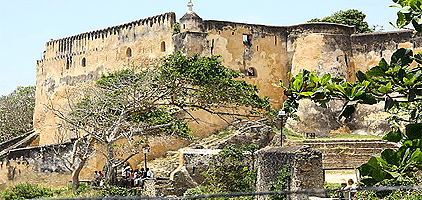
The Portuguese built Fort Jesus in 1593. The site chosen was a coral ridge at the harbor entrance. An Italian Architect and Engineer, Batista Cairato, designed the Fort. The earliest known plan of the fort is in a manuscript atlas by Manuel Godinho de Heredia, dated 1610, that shows the original layout of the buildings inside the Fort.
The Portuguese regarded themselves as the representatives of Christendom rather than of Portugal, and as a result, they sailed under the flag of the Order of Christ; Jesus was therefore an obvious name for the new fort. Fort Jesus was built to protect the Portuguese living on the East Coast of Africa.
It has had a long history of hostilities between the interested parties who used to live in Mombasa. Perhaps no Fort in Africa has experienced such turbulence as Fort Jesus. Omani Arabs attacked the fort from 1696 to 1698.
The state of the fort can be understood from the plan of Rezende of 1636 and other plans by Don Alvaro Marquis of Cienfuegos and Jose Lopes de Sa, made during the brief reoccupation by the Portuguese in 1728 – 1729.
In the Cienfuegos plan, the names of the bastions are changed. Between 1837 and 1895, the Fort served as barracks for soldiers. When the British protectorate was proclaimed on 1st July 1895, the Fort was converted into a prison. The huts were removed, and cells were built.
On 24th October 1958, Fort Jesus was declared a National Park, placed under the custody of the Trustees of the Kenya National Parks. Excavation was carried out, and the fort became a Museum in 1962.
The Fort Jesus Museum was built with a grant from the Gulbenkian Foundation. The exhibits consist of findings from archaeological excavations at Fort Jesus, Gede, Manda, Ungwana, and other sites. Individuals, notably Mrs. J.C. White, Mr. C.E. Whitton, and Mrs. W.S. Marchant, donated other objects on display.
In 2011, it was declared a World Heritage Site by UNESCO and highlighted as one of the most outstanding and well-preserved examples of 16th-century Portuguese military fortifications.
Fort Jesus has retained its basic shape from when it was built nearly 400 years ago.
It bears physical witness, in its structures and subsequent transformations, to the interchange of cultural values and influences among peoples of African, Arab, Turkish, Persian, and European origin who fought to gain and maintain control over this strategic port.
Currently, the Fort is also used to showcase art exhibitions by emerging artists, enabling them to meet prospective clients who tour the Fort. A sound-and-light show is held weekly, telling an animated story of the fort to both local and international tourists. The site is located on Mombasa Island, which is on the coast of Kenya
Jumba La Mtwana House
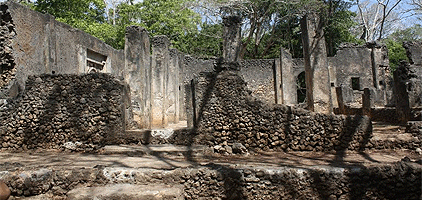
The full name Jumba la Mtwana means in Swahili “the large house of the slave”. Within this area, four mosques, a tomb, and four houses have survived in recognizable condition. These houses include the House of the Cylinder, the House of the Kitchen, the House of the Many Pools, which had three phases, and the Great Mosque. The inhabitants of this town were mainly Muslims, as evidenced by a number of ruined mosques.
Jumba la Mtwana, a picturesque ruined village, is situated in Kilifi along the Kenyan coast. The site lies some 15 kilometers north of Mombasa, on and above the beach, about 1000 meters north of the mouth of Mtwapa Creek; 4 kilometers from the Mombasa-Malindi road; and extends along the shore for about 300 meters and 250 meters inland.
There are no written historical records of the town, but ceramic evidence indicates it was built in the fourteenth century and abandoned early in the fifteenth century. The dating is based on the presence of a few shreds of early blue-and-white porcelain with lung-chuan celadon and the absence of any later Chinese wares.
It is most likely that the site’s strategic position was selected because of the presence of fresh water, exposure to the North East and South East breezes which would keep the people cool, and its safe location from external attacks by sea since it had no harbor, thus larger vessels had to anchor along way offshore, or move probably in Mtwapa creek. One can therefore only guess at the reasons for its eventual desertion, namely, trade interruption, hostile invasion, or a failure in water supply.
Clearance and excavation of the ruins were first carried out in 1972 by James Kirkman with a view to dating the buildings, determining their period of occupation, and consolidating those in danger of collapse. Ten years later, Jumba la Mtwana was gazetted on 04/06/82 under Gazette Notice Number 1515 as a National Monument.
Our Mombasa historical sites include lunch at Jumba Ruins Monsoons Restaurant and a later visit to a local school, before returning to your accommodation in the early evening, bringing your action-packed day tour to a close.
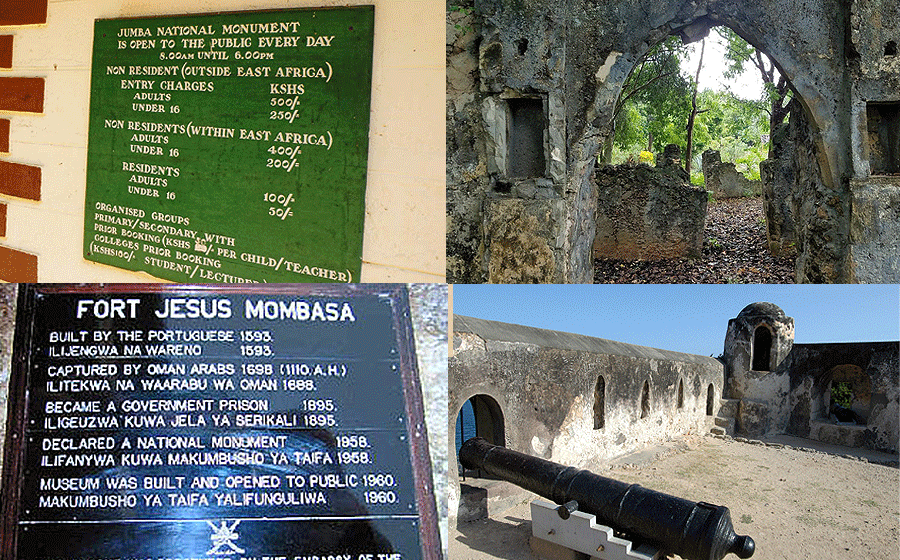
1 Day Fort Jesus Museum & Jumba Ruins Site historical tour of Mombasa explores the historical sites of Mombasa, which include Fort Jesus and Jumba Ruins. A visit to a local school is also included. Our Mombasa historical sites tour begins with a visit to the Fort Jesus Museum.
Wandering the fort grounds is an insightful journey through Mombasa’s history. The fort, located along the coastline near the Old Town, is a monumental piece of architecture built in the 16th century by the Portuguese.
Fort Jesus Museum displays various artifacts from the era when Mombasa served as a transit point for the slave trade and commodities, and which enjoyed regular visits by seafarers and the like. Its interior comprises torture rooms and prison cells where slaves were kept in captivity before being traded.
Weapons such as cannons, used to defend the fort against invading foreigners and rioting locals, can be seen both inside and outside the fort. The fort opens its gates for viewing in the morning and closes at dusk. The museum opened in 1962 and has become a popular attraction for tourists, students, and researchers.
Our historical sites of Mombasa tour also visits Jumba la Mtwana. This museum was opened to the public in 1973 and was gazetted as a national monument in 1982. Jumba la Mtwana, also known as “Jumba Ruins,” is located approximately 20 kilometers north of Mombasa in Mtwapa.
The site represents the remains of a 14th-century Swahili settlement that was occupied for about one century before abandonment. While the name literally means “large house of the slave”, there is neither historical nor archaeological evidence that suggests that this may have been the case.
There are no historical records of the settlement; as a result, what is known has been deduced from the ruins, excavated by James Kirkman in 1972. The settlement was likely built around 1350, inhabited, and then abandoned a century later. It is not certain whether ‘Jumba la Mtwana’ was the settlement’s name at the time of occupation.
However, one thing that is certain is that the inhabitants were Muslim, evidenced by the ruins of 4 mosques, washing platforms,s and water cisterns. There are ruins (old coral stone walls) of 4 mosques, 4 domestic houses, and a tomb that has survived in recognizable condition, situated among huge baobab trees on grassy slopes that descend to the sea.
These ancient ruins offer a sense of what life must have been like over 600 years ago, when they were home to the Swahili fishermen, craftsmen, and merchants who traded precious products from the African interior with their maritime trading partners in India and Arabia.
Excavations of the site have revealed numerous artifacts, including decorated local pottery and shell beads, imported Chinese and Islamic ceramics, and glass beads. We have lunch at Jumba Ruins Monsoons Restaurant and later visit a local school before returning to your hotel/ residence.
Mombasa City Tours 1 Day Fort Jesus Jumba Ruins Trip Prices
1-Day Fort Jesus Jumba Ruins Trip Rates Includes:
✓ Professional English-speaking guides
✓ All entry fees, guide fees, service charges, and taxes
✓ Mombasa City Tours 1 Day Fort Jesus Jumba Ruins Trip
✓ Pickup from your hotel in Mombasa and drop-off at your hotel
| Dates From | Dates To | Price Per Person | Children Aged 3 to 12 Years |
|---|---|---|---|
| 1st January 2026 | 31st December 2026 | Request for rates | Request for rates |
Notes
* Our 1-Day Fort Jesus Jumba Ruins Trip time: 0900 Hours – 1600 Hours
1-Day Fort Jesus Jumba Ruins Trip Rates Do Not Include:
* Drinks
* Laundry
* Tips or gratuity
* Travelers Insurance
* Communication charges
* Lunch (option and extra charges direct)
* Visas, international airfares, and airport taxes
* Sightseeing not included in the package; optional activities
* Personal expenses such as transfers to/ from the airport (supplement airport transfer cost applies for tours starting from the airport)
Booking & Reservations 1 Day Fort Jesus Museum & Jumba Ruins Site Historical Tour Contact
Mobile: +254-721-242-711
WhatsApp: +254-721-242-711
Reservations: +254 718-179-967
Email: [email protected]
Website: https://africanspicesafaris.com