
Mount Elgon National Park | Located in Bungoma & Trans-Nzoia Counties
Mount Elgon National Park & Reserve is a pristine natural sanctuary located in western Kenya, near the border with Uganda. Named after an ancient, extinct volcano that boasts the largest volcanic base in the world, the park covers an area of 1,279 square kilometres on the Kenyan side, offering a unique blend of landscapes and ecosystems.
Straddling the Kenya–Uganda border, Mount Elgon is a shield volcano whose highest peak, Wagagai, rises to 4,321 metres (14,177 ft) on the Ugandan side — the eighth-highest peak in Africa.
On the Kenyan side, Koitoboss Peak reaches 4,155 metres. Despite its grandeur and accessibility, Mount Elgon is far less frequented than Africa’s higher mountains, making it a true hidden gem for outdoor enthusiasts and nature lovers.
The park’s ecosystems are remarkably diverse, ranging from montane forests at lower altitudes — home to Elgon teak, cedar, and olive trees — through bamboo and Podocarpus zones, dense heath, and finally open alpine moorlands carpeted with giant lobelia and groundsel plants.
These dramatic altitude-driven changes support exceptional biodiversity and make the park a significant water catchment area, with several rivers originating from the mountain and feeding both Lake Victoria and Lake Turkana.
Location & Accessibility
The park is situated in western Kenya, approximately 420 km from Nairobi, near the border with Uganda. The main entrance on the Kenyan side is Chorlim Gate, accessible from the nearby town of Kitale.
By Road:
✓ Distance from Nairobi: Approximately 420 km via tarmac road
✓ Nearest Major City: Eldoret, approximately 150 km from the park
✓ Nearest Town: Kitale, approximately 35 km from the park — ideal as a base for visitors
✓ Main Route: Drive from Nairobi to Kitale (approx. 8 hours), then a murram road leads to Chorlim Gate — the primary Kenyan entrance
By Air:
✓ Airstrip: Kitale Airstrip serves as the primary air access point for the park
✓ Flights: Flights are available from Nairobi (Wilson Airport) to Kitale, followed by a road transfer to the park
Wildlife & Animals
Mount Elgon offers visitors an exceptional opportunity to observe wildlife up close, particularly as you hike through the park’s diverse ecosystems. The lower slopes are frequented by large mammals, including elephants and buffalo, while the forests shelter a rich array of primates and smaller mammals.
Mammals:
✓ Small Mammals: Rock hyrax, tree hyrax, and white-tailed mongoose
✓ Elephants & Buffaloes: Commonly seen on the lower slopes, roaming freely in herds
✓ Antelope & Herbivores: Zebras, bushbucks, waterbucks, elands, suni, and black-fronted duikers
✓ Rare & Elusive Species: Leopard, bongo (forest antelope), and giant forest hog — rarely seen due to their shyness
✓ Primates: Black-and-white colobus monkeys and blue monkeys are easily spotted due to their distinctive colouring
Birdlife:
Mount Elgon National Park is an ornithological paradise, home to over 300 recorded bird species, including more than 40 restricted-range species and 56 of the 87 Afrotropical highland biome species.
✓ Best Viewing: Dawn and dusk along forested trails, riverbanks, and moorland edges
✓ Sunbirds: Tacazze Sunbird and Golden-winged Sunbird, attracted to the park’s rich floral diversity
✓ Raptors: Lammergeier (bearded vulture), hawks, eagles, and owls patrol the skies and mountain ridges
✓ Forest Birds: Hartlaub’s Turaco, Eastern Bronze-naped Pigeon, and Jackson’s Francolin in the montane bamboo zones
The Famous Elephant Caves
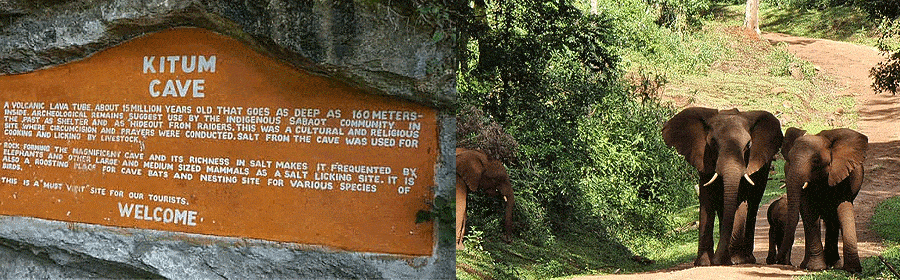
One of Mount Elgon’s most extraordinary and unique attractions is its network of caves, carved into the volcanic rock and rich in mineral salts. These caves famously attract elephants, who venture deep inside to mine salt deposits using their tusks — a behaviour unlike anything found in most other African parks.
✓ Kitum Cave: The most popular cave in the park, extending approximately 200 metres into the volcanic mountain. Its walls bear centuries-old tusk marks from elephants mining salt deposits. The cave holds deep cultural significance for the local Elgeyo and Sabaot tribes, whose ancestors lived here and who still conduct rituals within its walls
✓ Mackingeny Cave (Making’eny): Features a dramatic entrance adorned by a cascading waterfall. Rich in mineral salts, it attracts elephants and other wildlife. A moderate hike through scenic forest trails leads to this unforgettable natural wonder
✓ Chepnyali Cave: A natural wonder enchanting visitors with stunning stalagmites and stalactites formed over centuries by slow-dripping mineral-rich water. An otherworldly subterranean world with the sounds of dripping water and bats flitting in the shadows
Hiking & Trekking
Mount Elgon offers some of East Africa’s most rewarding and varied hiking experiences, from short scenic trails to multi-day summit treks. The park’s dramatic altitude changes create a rich tapestry of landscapes, dense forests, bamboo stands, misty moorlands, and volcanic rock formations, all of which are traversable on foot.
Key Hikes:
✓ Kitum Cave Trail: A short, accessible hike leading to the park’s most iconic geological feature — perfect for day visitors
✓ Nature Walks: Designated walking trails through montane forests, bamboo zones, heath, and moorland, offering chances to see birds, primates, and wildflowers
✓ Endebess Bluff: A ranger-guided hike with a moderate 45-minute climb through steep sections and dense forest, rewarded with panoramic views of the park, Kitale town, and parts of Uganda
✓ Koitoboss Peak (4,155 m): The highest point on the Kenyan side. A multi-day trek (typically 5 days) beginning at Chorlim Gate, passing Mutamaiyu Camp under giant olive and Podocarpus trees, the Chesurur Waterfalls, and Endebess Bluff before reaching the moorland summit
Hiking Notes:
✓ Best Season: Outside the rainy season (June–August and December–March) for drier, safer trails
✓ Guides: Strongly recommended. The park is vast, and trails can be difficult to navigate independently
✓ Camping: Available at designated campsites along trekking routes, including Koitoboss Guesthouse & Campsite and Makutano Campsite
Activities
✓ Bird Watching: Over 300 species across multiple ecological zones — a paradise for birding enthusiasts
✓ Cultural Experiences: Engage with the local Sabaot community to learn about their rich traditions and way of life
✓ Camping: Immersive overnight stays at designated sites within the park, surrounded by pristine highland wilderness
✓ Multi-Day Trekking: Summit Koitoboss Peak on the iconic 5-day route through forests, moorlands, and volcanic landscapes
✓ Game Drives & Guided Walks: Explore the park’s diverse ecosystems with KWS rangers, encountering wildlife at close range
✓ Cave Exploration: Visit Kitum, Mackingeny, and Chepnyali caves for a geological and wildlife spectacle unlike any other in Kenya
Climate & Best Time to Visit
✓ What to Bring: Rain gear and warm clothing are essential year-round due to the possibility of sudden weather changes at altitude
✓ Best Time to Visit: The two dry seasons — June to August and December to March — offer the most accessible trails, clearer skies, and better wildlife viewing as animals gather around water sources
✓ Climate: Moist to moderately dry, with an average annual rainfall of approximately 3,000 mm. The park has a cool highland climate due to its altitude, with possible snow, hail, and cold temperatures at higher elevations
✓ Rainy Seasons: April to May (long rains) and September to November (short rains). Trails become muddy and challenging, but waterfalls are spectacular, and migratory birds are present, ideal for birdwatching enthusiasts
Accommodation
Lodge & Guesthouse (Within the Park):
✓ Koitoboss Guesthouse & Campsite: Basic facilities including toilets and running water, ideally located for those beginning or ending their ascent of the peak
Camping (Within the Park):
✓ Koitoboss Guesthouse & Campsite: Adjacent to the trailhead, with basic shared amenities
✓ Makutano Campsite: Located near park headquarters; communal facilities; popular with hikers preparing for or returning from treks
Outside the Park (Kitale Town):
✓ Kitale: Recommended as a base for visiting the park. Numerous lodges, guesthouses, and hotels are available in town, along with internet access and supplies for multi-day hikes
Mount Elgon National Park Entrance Fees
2026 Mount Elgon National Park & Reserve Park Entrance Fees
|
East African Citizen |
Kenyan Resident |
Non-Resident |
African Citizen |
||||
|
Adult |
Child/ |
Adult |
Child/ |
Adult |
Child/ |
Adult |
Child/ |
|
500 |
250 |
675 |
350 |
50 |
25 |
20 |
10 |
Notes
* Child refers to persons from three years but below 11 years
* Resident refers to persons of other nationalities residing in Kenya with valid documentation from the Kenyan government
* Citizen – A native or inhabitant of East African countries (Kenya, Uganda, Tanzania, Rwanda, Burundi, and South Sudan) with valid identification documents or a passport
* Daily – Fee paid for a single entry to a national park, national reserve, or sanctuary, and which shall be valid for no longer than twenty-four hours
Mount Elgon National Park Facts
Mount Elgon National Park Vegetation | Ecosystem
Mount Elgon National Park & Reserve is a pristine natural sanctuary located in western Kenya, near the border with Uganda. The park is named after Mount Elgon, an ancient, extinct volcano that boasts the largest volcanic base in the world. It covers an area of 1,279 square kilometers on the Kenyan side, offering a unique blend of landscapes and ecosystems.
The park’s ecosystems are diverse, ranging from montane forests at lower altitudes to alpine moorlands at higher elevations. These ecosystems are home to a variety of flora, including the Elgon teak, cedar, and olive trees in the montane forests, and the peculiar giant lobelia and groundsel plants in the moorland zones.
The park’s vegetation zones result from dramatic changes in altitude and climate, providing habitats for a wide range of wildlife and supporting high biodiversity. Mount Elgon National Park & Reserve is not only a haven for nature lovers but also plays a crucial role as a water catchment area.
The park’s forests and vegetation help regulate the local climate and the flow of several rivers, which are vital for both the park’s ecosystems and the human communities that rely on them. As a protected area, the park helps conserve these important natural resources, making it a key component of the region’s ecological and hydrological stability.
Climate | Best Time to Visit
Mount Elgon National Park has a moist-to-moderately dry climate, with an average annual rainfall of about 3,000 mm, making it a significant water catchment area. The park experiences two main dry seasons, ideal for wildlife viewing and hiking: from June to August and from December to March. These periods are considered the best times to visit, as the weather is more favorable and the trails are passable.
While the park is open to visitors year-round, the wettest months are April to October. During this time, the park can be cold, with snow and hailstorms being common occurrences that may affect climbing experiences. Despite the challenging conditions, the park’s beauty is lush, and the waterfalls are particularly impressive during the rainy season.
For those planning to visit, it is advisable to bring rain gear and warm clothing, regardless of the season, due to the possibility of abrupt weather changes. The dry seasons offer clearer skies and drier trails, making them the optimal times for exploring Mount Elgon’s natural splendor.
Location | How to get to Mount Elgon National Park & Reserve
Mount Elgon National Park & Reserve is prominently positioned in western Kenya, near the border with Uganda. The park is approximately 420 km from Nairobi and can be accessed via a tarmac road to the town of Kitale. From Kitale, visitors can take a Murram road to the Chorlim Gate, the main entrance to the park on the Kenyan side.
For those who prefer air travel, flights are available from Nairobi to Kitale, followed by a road transfer to the park. The journey by air from Nairobi to Kitale offers a quick and scenic route to the park, providing an alternative to the 8-hour drive.
Mount Elgon National Park & Reserve is a cross-border park, with the Kenyan side covering 169 km² (65 square miles) of the total area. The park’s unique location makes it a significant water catchment area for the Nzoia River, which flows into Lake Victoria, and the Turkwel River, which flows into Lake Turkana. The park’s diverse terrain and dramatic altitudinal changes create distinct vegetation zones, offering visitors a variety of landscapes to explore.
Mammals | Wildlife & Animals
The park is a haven for numerous mammals, including the buffalo and elephants, which are often seen on the lower slopes where they roam freely. The forests are home to primates such as black-and-white colobus monkeys and blue monkeys, which are easily spotted for their distinctive coloration and playful nature.
Smaller mammals, such as the rock and tree hyrax, are also common in the park. These small creatures are known for their unique calls and can often be found basking on rocks or in trees. The white-tailed mongoose, suni, and black-fronted duiker are other species that thrive within the park’s boundaries, each adapted to specific niches within the ecosystem.
The park also provides a habitat for the mole rat, bushbucks, waterbuck, and elands. These animals contribute to the park’s ecological diversity and can be observed in various habitats, from forested areas to open grasslands.
Rarely seen but present in the park are the elusive leopard, the bongo (a type of forest antelope), the giant forest hog, and other shy species that tend to avoid human presence. These animals are a testament to the park’s role as a critical refuge for wildlife, including those that are under threat.
Bird Checklist | Birdlife
Mount Elgon National Park & Reserve is an ornithological paradise, boasting a remarkable diversity of bird species. With over 300 bird species recorded, the park is a critical habitat for both forest and highland birds. Among these, the park is home to over 40 restricted-range species and 56 of the 87 Afrotropical highland biome species.
The birdlife in Mount Elgon includes the majestic Lammergeier, or bearded vulture, known for its impressive wingspan and soaring flight above the park’s caldera. Birdwatchers can also spot a variety of sunbirds, including the Tacazze Sunbird and the Golden-winged Sunbird, which are attracted to the rich nectar sources provided by the park’s flora.
Other notable species include the Hartlaub’s Turaco, Eastern Bronze-naped Pigeon, and the Jackson’s Francolin, which is prominent in the montane forest vegetation and bamboo zones of the mountain. Owls, eagles, and nightjars add to the nocturnal soundscape, while ibises and hawks patrol the skies and ground for prey.
Activities | Things to do in Mount Elgon National Park
Hiking & Trekking
Koitoboss Peak, the highest point on the Kenyan side of Mount Elgon National Park, stands at 4,155 meters (13,852 feet) and offers a challenging yet exhilarating hike. The journey to the summit begins at Chorlim Gate and includes an overnight stay at Mutamaiyu Camp, nestled under giant African wild olive and Podocarpus trees.
Hikers traverse dense forests, encounter the Chesurur Waterfalls, and marvel at the Endebess Bluff before reaching the golden moorland that leads to Koitoboss Peak. The hike is a multi-day adventure, often spanning five days, and is known for its diverse flora and fauna, volcanic rock formations, and the iconic Kitum Caves, where elephants are known to visit for a unique salt lick experience.
You can also hike to Endebess Bluff, which combines high-elevation climbing with a jungle climate, resulting in inspiring views. The adventure begins with a ranger-guided drive to a somewhat hidden trailhead, followed by a moderate 45-minute climb through steep sections and dense forest.
At the summit, hikers are rewarded with panoramic views of the park, the city of Kitale, and even parts of Uganda. The hike is best undertaken outside the rainy season to avoid muddy trails, and while camping options are available, many prefer to stay at the park lodge for convenience.
Mount Elgon Caves
Kitum Cave: The most popular salt cave of Mount Elgon National Park in Kenya, is renowned for its unique geological formations and its connection to wildlife. This cavern boasts walls rich in mineral salts, attracting elephants and other animals who venture deep inside to obtain these essential nutrients. The cave’s walls bear the marks of elephants’ centuries-long mining for salt, creating a fascinating landscape within the earth.
Chepnyali Cave: a natural wonder nestled within the Kenyan side of Mount Elgon National Park, enchants visitors with its stunning geological formations. This expansive cave features towering stalagmites and stalactites, formed over centuries by the slow dripping of mineral-rich water.
The unique patterns and textures of these formations create an otherworldly ambiance. As you venture deeper into the cave, the darkness reveals a fascinating subterranean world, where the echoing sounds of dripping water and the sight of bats flitting in the shadows add to the sense of mystery and adventure.
Mackingeny Cave: This captivating highlight of Mount Elgon National Park in Kenya entices visitors with its dramatic entrance adorned by a cascading waterfall. The cave’s walls, rich in mineral salts, lure animals like elephants seeking essential nutrients.
This natural wonder offers a unique opportunity to witness wildlife interactions within the cave’s depths and capture breathtaking photographs of the surrounding scenery. The moderate hike through scenic forest trails adds to the adventure, making Making’eny Cave an unforgettable experience for nature enthusiasts and explorers alike.
Camping
Mount Elgon National Park offers several camping sites for visitors looking to immerse themselves in the park’s natural beauty. One of the notable camping sites is the Koitoboss Guesthouse and Campsite, which provides basic facilities such as toilets and running water.
It’s an ideal spot for those who wish to start their ascent to the peak of Mount Elgon. Another popular site is the Makutano Campsite, located near the park’s headquarters. It offers a more communal camping experience with shared amenities and is a great option for hikers who are preparing for or returning from their trek.
Nature walks
Mount Elgon National Park nature walks take visitors on a journey across diverse ecological zones. Starting in the montane forests, walkers are surrounded by a rich array of flora and fauna, including rare bird species and small mammals. Ascending through the bamboo and Podocarpus zone, the biodiversity peaks with thick bamboo stands and towering trees.
The heath zone introduces a landscape of dense scrub and vibrant wildflowers, while the moorland zone offers expansive grasslands with giant lobelia and groundsel plants. Trails like the Endebess Bluff provide breathtaking vistas, and the Kitum Cave trail leads to the intriguing geological formations that the park is renowned for. These walks not only offer a chance to witness the park’s unique vegetation and wildlife but also to engage with the serene beauty of Mount Elgon’s Kenyan highlands.
Booking & Reservations Mount Elgon National Park Contact
Mobile: +254-721-242-711
WhatsApp: +254-721-242-711
Reservations: +254 718-179-967
Email: [email protected]
Website: https://africanspicesafaris.com