
Sweetwaters Chimpanzee Sanctuary | Ol Pejeta Conservancy | Laikipia
The Sweetwaters Chimpanzee Sanctuary is a protected lifelong refuge for rescued chimpanzees inside Ol Pejeta Conservancy in Laikipia County, Kenya. Established in 1993, it is the only chimpanzee sanctuary in Kenya and one of the conservancy’s most important wildlife welfare and conservation education projects.
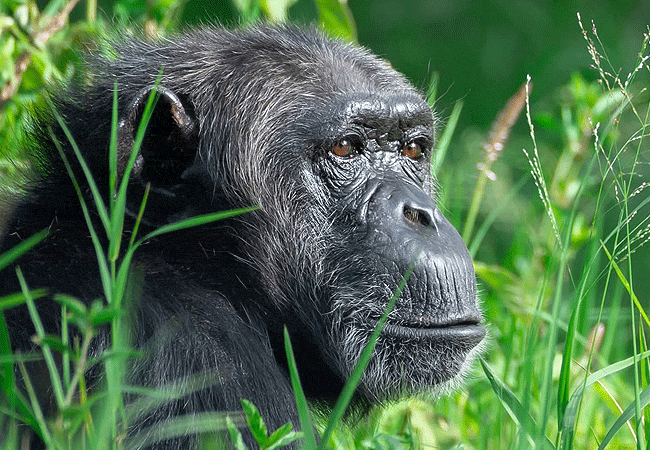
Chimpanzees are not native to Kenya. Their natural range spans West and Central Africa through to Uganda, but every resident here has a rescue, confiscation, or sanctuary history, arriving from conditions of trafficking, abuse, or unsuitable captivity to receive lifelong care. Sharing 98.6% of their DNA with humans, these chimpanzees are a wild cousin of ours in the truest sense: they laugh when they play, hug to show affection, and walk upright, and at Sweetwaters, they get the chance to start over.
Visitors can observe the resident chimpanzees from protected public viewing areas, learn how illegal trade affects Africa’s great apes, and see how sanctuary care supports animals that cannot safely return to the wild. Standard sanctuary access is included in the applicable Ol Pejeta entrance fee, while the more detailed behind-the-scenes chimpanzee experience requires advance booking and separate payment.
Location & Accessibility
Ol Pejeta Conservancy sits on the Laikipia Plateau in central Kenya, on the equator, between the foothills of the Aberdares and Mount Kenya, spanning approximately 90,000 acres (364 km²) of mixed grassland, bush, and riverine forest.
By Road
✓ From Samburu: Approximately 140 km via Isiolo
✓ Nearest town: Nanyuki, approximately 14–17 km away
✓ From Nakuru: Approximately 180 km via Nyahururu
✓ 4×4 vehicles recommended during the rainy season, as the final stretch of road can be affected by weather
✓ From Nairobi: Approximately 200–217 km, roughly 3.5 to 4.5 hours by road via the A2/Thika–Nanyuki Road
By Air
✓ From Nanyuki Airstrip, a further 30–45 minute drive to reach the conservancy
✓ Daily scheduled and charter flights from Nairobi’s Wilson Airport to Nanyuki Airstrip, roughly 45 minutes to 1 hour
Within the Conservancy
✓ Most visitors enter via the Serat Gate (main gate from Nanyuki) or the Rongai Gate
✓ The Sweetwaters Chimpanzee Sanctuary itself keeps separate, shorter hours within the conservancy (more on this in the Visiting Information section)
History & Founding
The Sweetwaters Chimpanzee Sanctuary was established in 1993, when a chimpanzee rescue center in Burundi was forced to close amid the outbreak of civil war. The animals needing a secure refuge had to be relocated, and Ol Pejeta stepped in, opening its doors to establish what would become Kenya’s only chimpanzee sanctuary. Ol Pejeta has been advocating for the plight of chimpanzees and other great apes ever since.
The sanctuary was founded through a formal agreement between the Ol Pejeta Conservancy, the Kenya Wildlife Service (KWS), and the Jane Goodall Institute, with the shared aim of providing lifelong refuge to orphaned and abused chimpanzees from West and Central Africa. Each institution brought something essential to that founding agreement:
✓ Ol Pejeta Conservancy provided the land, infrastructure, and long-term operational home for the sanctuary
✓ The Jane Goodall Institute connected the new sanctuary with established chimpanzee rescue expertise and helped facilitate the safe transfer of animals displaced from the closed Burundi facility
✓ Kenya Wildlife Service carried Kenya’s legal and institutional responsibility for wildlife conservation, animal movements, and veterinary regulation authorizing transfers, coordinating confiscations, and later participating directly in comprehensive chimpanzee health evaluations alongside Ol Pejeta’s own veterinary team
Dr Jane Goodall’s connection to Sweetwaters has continued well beyond that founding agreement. A lifelong advocate for chimpanzee welfare, she has maintained an active relationship with the sanctuary through ongoing advocacy and personal visits, including a 2016 visit alongside the Director General of the Kenya Wildlife Service and Kenya’s Director of Veterinary Services.
While Sweetwaters is accurately described as part of Ol Pejeta Conservancy rather than a Jane Goodall Institute facility, her influence on the sanctuary’s founding principles and its continued advocacy work remains a defining part of its story.
Since opening its doors, Sweetwaters has been compelled to keep accepting chimpanzees rescued from traumatic situations. Many arrive confiscated from cramped, unnatural living conditions; many arrive with horrific injuries sustained from abuse at the hands of humans. Today, the sanctuary is home to 29 chimpanzees, each one given the chance, at Sweetwaters, to start over.
Part of a Wider Network
Sweetwaters is a chartered member of the Pan African Sanctuary Alliance (PASA), an alliance of 18 sanctuaries across 12 African countries currently caring for over 800 orphaned and confiscated chimpanzees between them.
PASA’s role is to help conserve chimpanzees and other primates and their habitats through public education and lobbying for political goodwill, a mission Sweetwaters has carried forward through its own conservation and advocacy work, including a three-year grant (May 2014–May 2017) that funded the Project to End Great Ape Slavery (PEGAS), aimed at understanding the illegal trade in great apes, documenting trafficking routes, and campaigning for stronger enforcement of international wildlife law.
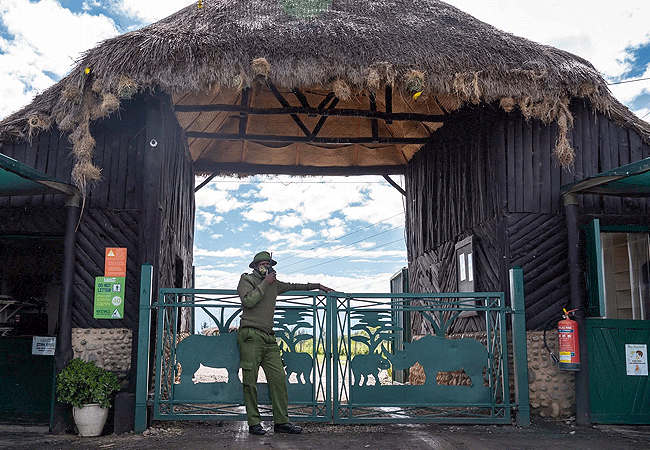
About the Chimpanzees in the Sweetwaters Chimpanzee Sanctuary
What Chimps Are, and Their Relation to Us
The chimpanzee (Pan troglodytes) is a species of great ape found across western and central Africa, alongside gorillas and orangutans in that same “great ape” classification, and it is our closest living wild cousin, sharing 98.6% of our DNA. The resemblance goes well beyond biology: like us, chimpanzees laugh when they play with each other, hug to show affection, and walk upright. Sadly, only around 150,000–200,000 chimpanzees remain in the wild today, classifying them as Endangered by the International Union for Conservation of Nature (IUCN).
Chimpanzees are part of the great ape family along with orangutans, gorillas, and bonobos. Adult males stand over a meter tall and weigh between 35 and 70 kilograms, with long arms built for climbing and nimble hands and feet with opposable thumbs for grasping objects and branches.
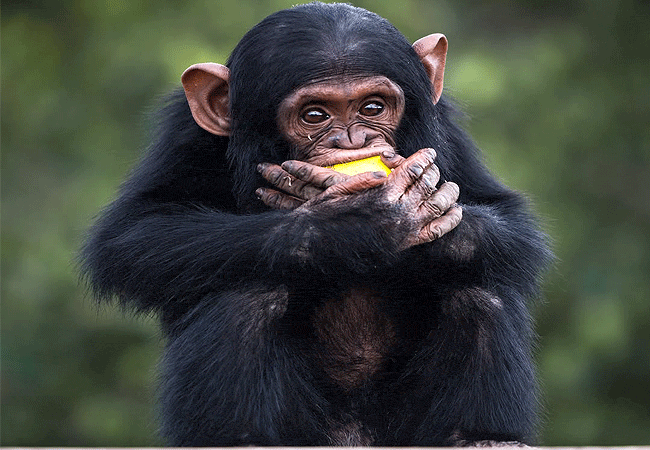
They’re omnivores; their diet mainly consists of ripe fruit, young leaves, and seeds, though they’ll also eat insects, eggs, nestlings, and occasionally hunt small mammals. Chimpanzees are extremely sociable, living in complex communities of between 15 and 100 individuals, led by a dominant “alpha” male whose position is shaped by physical strength, age, intelligence, and, much like human politics, popularity and alliances.
They spend hours grooming each other as a sign of affection, submission, and bonding, and at dusk, wild chimpanzees build nests 6–25 meters above ground by pulling over branches to make a soft bed.
Chimpanzees are also remarkably intelligent. They’re the only primates other than humans to have developed tool use to such an advanced level, using rocks to crack tough nuts and long, thin twigs to fish for termites. They learn by observing others, remember relationships and past interactions, solve practical problems, form coalitions, communicate through gestures, vocalizations, and facial expressions, and even reconcile after conflict. Life expectancy is 40–50 years in the wild and around 60 in captivity.
Their Origins Before the Sanctuary
None of the chimpanzees at Sweetwaters are native to Kenya; the species’ natural range runs from Senegal on the West African coast, through the central forested belt of Africa, to Uganda. Every resident here arrived through rescue, confiscation, or transfer, not natural migration, and most became captive through a combination of interlinked threats rather than a single isolated incident.
The main routes into captivity include:
✓ The bushmeat trade: Infants surviving after adults in their community are killed for meat, then sold into the pet trade
✓ Captive entertainment and the pet trade: Chimpanzees used as private pets, circus performers, photography props, tourist-entertainment animals, or customer attractions outside businesses
✓ Illegal wildlife trafficking: Chimpanzees smuggled across borders, through airports and seaports, using false documents, concealed among legal cargo, or sold to unregulated facilities and private collections
Recorded countries connected to Sweetwaters’ residents include Burundi, the Democratic Republic of the Congo (formerly Zaire), Guinea-Bissau, Cameroon (or suspected Central African origins), South Sudan and neighboring transit areas, and Iraq, in the case of one chimpanzee rescued from captivity outside Africa entirely.
A recorded country of rescue isn’t necessarily an animal’s original wild range; trafficked chimpanzees often pass through several countries, and confiscation documents can be incomplete. This uncertainty is actually one reason release back to the wild is so difficult: conservation teams may not know a chimpanzee’s exact subspecies, natal population, or appropriate forest of return.
Their Lives at the Sanctuary: Care, Routine, and Feeding
Chimpanzees arriving at Sweetwaters are carefully nursed back to health with 24-hour veterinary support in a stimulating quarantine enclosure, where they’re assessed, treated, and gradually acclimatized before being introduced — when ready — into one of the sanctuary’s two large social groups.
The Sweetwaters Chimpanzee Sanctuary covers roughly 250 acres (about 100 hectares) of natural riverine forest, split into two large, separate enclosures divided by the Ewaso Nyiro River, allowing the chimpanzees to live in a near-wild, open environment where they can walk, climb, forage, and form smaller social parties much as they would in the wild.
A typical day follows a rhythm of managed care balanced with freedom to make choices within that secure environment:
✓ Scheduled morning feeding
✓ Grooming and social interaction
✓ Foraging, exploration, and tool use
✓ Afternoon feeding and welfare checks
✓ Morning health observations by caregivers
✓ Return to secure night facilities in the evening
✓ Movement into the outdoor forested enclosures
✓ Environmental enrichment: hidden or scattered foods, puzzle feeders, climbing structures, and novel objects that encourage natural, species-appropriate behavior
Feeding is more than routine; it’s core to their rehabilitation. Chimpanzees are predominantly fruit-eating omnivores, and their managed diet includes fruits, vegetables, leafy material, seeds, nuts, and occasional protein sources, often scattered, hidden, or placed in puzzle devices to encourage natural foraging behavior rather than simply handed over. Currently, 29 chimpanzees call Sweetwaters home, each with an individual history, routine, and place within one of the sanctuary’s two social groups.
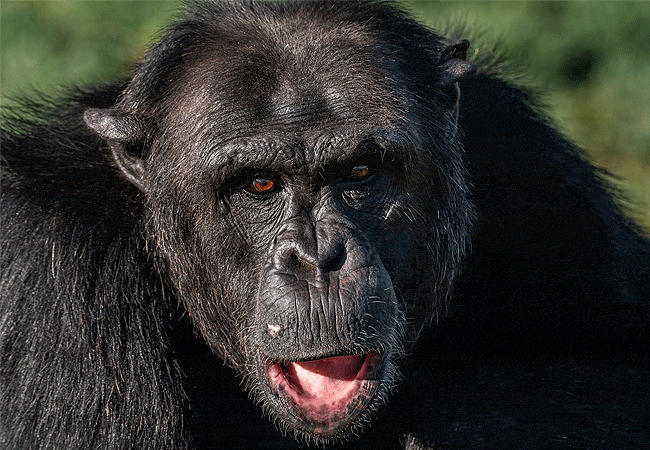
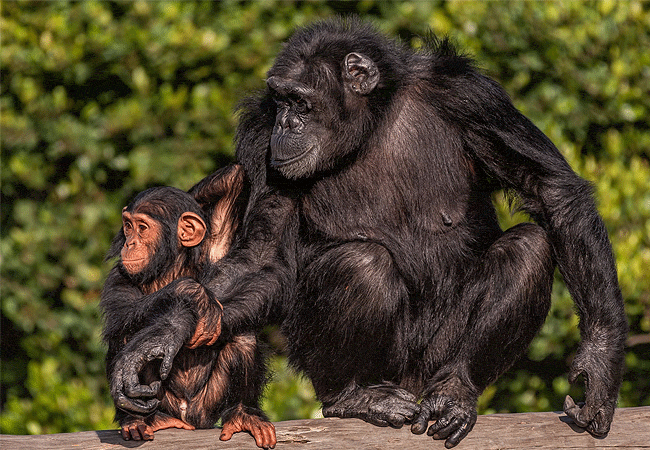
Sweetwaters Chimpanzee Sanctuary Rehabilitation and Care
How a Chimpanzee Is Rescued and Transferred
A chimpanzee rescue and transfer can take months, sometimes years, and typically involves wildlife authorities, veterinarians, sanctuary specialists, courts, CITES authorities, airlines, and organizations across several countries.
A responsible transfer generally works through legal confiscation or surrender, confirmation of a receiving sanctuary, review of transport and wildlife documentation, veterinary assessment and disease testing, a secure transport crate, route and airline approval, customs and wildlife clearance, and finally arrival and immediate placement into quarantine.
Manno’s transfer from a zoo in Iraq to Sweetwaters in 2016 reportedly followed more than two years of international coordination, a case that illustrates why moving a great ape is nothing like transporting an ordinary domestic animal. Poco’s history tells a different kind of story: he spent years in a suspended cage above a workshop in Burundi, used to attract customers, and the restricted space affected his normal movement so severely that part of his rehabilitation involved simply relearning to knuckle-walk.
Quarantine and Veterinary Care
An arriving chimpanzee is never placed directly into a resident group. It may carry an infectious disease, need emergency treatment, or be unable to cope socially straight away, so every new arrival goes through a stimulating quarantine enclosure backed by 24-hour veterinary support.
Quarantine can involve separation from resident groups, restricted staff access and protective hygiene protocols, close observation of appetite and behavior, collection of blood, fecal, or other diagnostic samples, screening for infectious disease and parasites, nutritional assessment, treatment of wounds or chronic conditions, and gradual acclimatization to the sanctuary environment.
Veterinary examinations continue well beyond arrival, assessing body condition, teeth and oral health, musculoskeletal injuries, skin and hair condition, heart and respiratory function, gastrointestinal health, parasites, reproductive health, infectious-disease exposure, and evidence of past trauma.
Ol Pejeta’s 2021 health program involved specialists from Ol Pejeta, KWS, the University of Nairobi, the University of Minnesota, and volunteer wildlife veterinarians, carrying out full organ-system reviews and laboratory sampling. Because chimpanzees can contract some human diseases, staff and visitor health protocols form an important part of this preventive medicine.
Rehabilitation and Social Integration
Rehabilitation is the gradual process of helping a rescued chimpanzee recover physically, psychologically, and socially, not training an animal for public display. It can involve treating injuries and disease, correcting malnutrition, building predictable daily routines, reducing fear of caregivers, encouraging natural movement, developing independent feeding and exploration, and introducing appropriate enrichment.
Recovery is individual: a chimpanzee that experienced years of isolation may need far more time to interpret social signals, manage conflict, or learn to trust other chimpanzees again.
Because chimpanzees have complex relationships, alliances, and hierarchies, introductions to a new social group happen gradually and carefully, moving from hearing or smelling other chimpanzees, to seeing others through a secure separation, to limited protected interaction, to direct introduction with selected individuals, to a small subgroup, and finally into a larger community, with continued behavioral monitoring throughout.
Age, sex, temperament, health, previous experience, and existing group relationships all shape how that process unfolds. When ready, new residents are introduced into one of Sweetwaters’ two large social groups, where relationships mirror those of wild communities: long-term friendships, grooming partnerships, maternal bonds, play partnerships, male alliances, dominance relationships, and support for older or disabled individuals.
Many residents lost their mothers at a very young age, and while caregivers can provide safety and structured rehabilitation, they can’t fully replicate the developmental experience of growing up within an intact wild community.
Enrichment and Behavioral Management
Good enrichment gives chimpanzees physical, cognitive, sensory, and social challenges that encourage natural, species-appropriate behavior: hidden or scattered foods, puzzle feeders, climbing structures, ropes and platforms, natural browse and vegetation, novel safe objects, and tool-use tasks.
One notable Sweetwaters project used an artificial termite mound to encourage “fishing” with sticks, recreating the same problem-solving sequence wild chimpanzees use to extract termites from narrow openings. The best enrichment is safe, varied, voluntary, behaviourally relevant, adapted to the individual, and evaluated by caregivers, never staged merely for visitors.
Behavioral management works alongside this, using close knowledge of chimpanzee behavior to protect welfare and keep care routines safe: monitoring social compatibility, recording aggression and affiliation, adjusting group composition when necessary, designing individual enrichment, and reducing stress around veterinary care. Positive-reinforcement training encouraging an animal to voluntarily present a body part, enter a transport space, or cooperate with a visual exam reduces the need for restraint or anesthesia altogether.
Population Management
Sweetwaters follows a generally non-breeding policy, not because breeding is discouraged for its own sake, but because the sanctuary’s principal mission is caring for rescued chimpanzees rather than growing a captive population; limited space and resources need to stay available for orphaned or confiscated chimpanzees who need refuge.
Ol Pejeta has reported using contraceptive implants in mature females to help maintain natural social opportunities while avoiding unnecessary births. No method is infallible, though the sanctuary’s historical records include chimpanzees born on-site, including Judy’s son Oscar. The ethical distinction matters: preventing planned breeding doesn’t reduce the value of an unexpected infant, and every chimpanzee born or received still receives the same lifelong care as any other resident.
Why Rescued Chimpanzees Can’t Be Released
Survival in the wild takes far more than access to forest. A responsible release would require reliable knowledge of an animal’s geographic origin, appropriate subspecies and population matching, suitable protected habitat, freedom from communicable disease, natural foraging knowledge, predator and danger avoidance, appropriate social behavior, and long-term post-release monitoring among other conditions.
Many Sweetwaters residents arrived after years of human contact, and some carry lasting physical disabilities, abnormal learned behavior, or incomplete records of origin. Releasing them into unfamiliar chimpanzee territory could expose them to starvation, injury, rejection, disease, or death. Lifelong sanctuary care isn’t a failure of rehabilitation for chimpanzees who can’t safely return to the wild; it’s the responsible welfare outcome.
The People Behind the Care
None of this is possible without the sanctuary’s staff and caregivers, whose daily work includes preparing and distributing food, cleaning night quarters and service areas, monitoring health and behavior, maintaining enrichment programs, assisting with veterinary procedures, recording changes in social relationships, and responding to emergencies. Caregivers often notice subtle changes in appetite, movement, posture, or social behavior before a problem becomes obvious; their daily observations are, in many ways, the first line of preventive veterinary care at Sweetwaters.
Ol Pejeta Conservancy | Sweetwaters Chimpanzee Sanctuary Entry Fee
2026-2027 Ol Pejeta Conservancy Entry Fees
| East African Citizen | East African Resident | Non-Resident | |
| Adult | 2,000 Kenya Shillings | 3,500 Kenya Shillings | 110 US Dollars |
| Child (3 – 11 Years) | 1,000 Kenya Shillings | 1,750 Kenya Shillings | 55 US Dollars |
| Student | 500 Kenya Shillings | 500 Kenya Shillings | 32 US Dollars |
Note
* Sweetwater’s Chimpanzee Sanctuary Open daily from 8:30 am – 12:30 pm | 2:00 pm– 4:30 pm (Free Entry)
Sweetwaters Chimpanzee Sanctuary Visitor Information & Highlights
Visiting Information
The Sweetwaters Chimpanzee Sanctuary is open daily in two split sessions, giving the chimpanzees a protected midday break away from public viewing.
✓ Morning session: 0830 Hours – 1230 Hours
✓ Afternoon session: 1400 Hours – 1630 Hours
✓ Midday closure: 1230 Hours –1400 Hours
This closure period should be built into any itinerary; arriving around 12:40 pm, for example, could mean waiting until the afternoon reopening. Note that the sanctuary keeps shorter hours than Ol Pejeta’s own gates: the Rongai and Serat gates operate from 07:00 Hours to 1900 Hours, but the sanctuary itself closes earlier.
Hours can also shift due to veterinary work, chimpanzee health, enclosure maintenance, weather, or other welfare considerations, so it’s worth confirming current arrangements against the official Ol Pejeta tariff guide before visiting.
What Visitors Can See
From secure public viewing areas, across a protected barrier rather than inside the chimpanzees’ living space, visitors may observe grooming, feeding, resting, climbing, tool manipulation, social play, displays or vocalizations, and chimpanzees moving through vegetation.
The chimpanzees control where they spend their time, though, so a visitor might see several animals clearly, see them only at a distance, or find that some residents stay out of view entirely; wildlife welfare always takes priority over guaranteed photographs.
✓ Allow approximately 45–60 minutes for a standard visit
✓ Factor in driving time between the sanctuary and Ol Pejeta’s entrance gates, restaurants, and other attractions
✓ Allow more time if conservation is your main interest, if you’re traveling with children, if you want to read the interpretation displays carefully, or if you’ve booked the behind-the-scenes experience
Behind-the-Scenes Chimpanzee Experience
For a deeper look at the sanctuary’s care program, the behind-the-scenes chimpanzee experience offers exclusive access during feeding time and enrichment activities, with the caregiver team on hand to share individual chimpanzee histories and answer questions.
✓ Requires advance booking and a separate payment, on top of standard sanctuary access
✓ Offers a rare opportunity to watch enrichment activities and feeding up close, alongside expert commentary
✓ Scheduled around 1145 Hours – 1245 Hours, though visitors should confirm the current program directly when booking
✓ Covers individual chimpanzee histories, caregiver responsibilities, food preparation, enrichment, and social-group management
A Good Sequence for the Day
✓ Reach Sweetwaters before late morning
✓ Visit during the morning opening session
✓ Have lunch during or after the midday closure
✓ Join the pre-booked 1145 Hours experience, if applicable
✓ Enter Ol Pejeta early and complete a morning game drive
✓ Continue on to the Morani Information Centre or another part of the conservancy
✓ An afternoon visit from 1400 Hours is also possible; just allow enough time before the 1630 Hours closure
Visitor Conduct
Because chimpanzees share susceptibility to several human infections, and because their wellbeing always comes first, visitor conduct at Sweetwaters is taken seriously.
✓ Take all litter away with you
✓ Remain behind all barriers at all times
✓ Keep hands away from enclosure fencing
✓ Follow caregiver and ranger instructions
✓ Avoid flash photography where prohibited
✓ Speak quietly and supervise children closely
✓ Avoid visiting if you have a transmissible illness
✓ Follow any mask or hand-sanitizing instructions in place
✓ Never throw food or objects, bang on barriers, or attempt to provoke a reaction
Visitors must never touch a chimpanzee, attempt a selfie through a barrier, offer food, mimic a threatening display, enter a staff-only area, or fly a drone without authorization, and no visit should ever promise or advertise guaranteed physical contact with the animals.
Accessibility
Accessibility can vary depending on the parking point, path conditions, weather, and viewing location, so travelers with reduced mobility should check directly with the conservancy on wheelchair access, path gradient and surface, distance from parking, accessible toilets, seating, guide assistance, and wet-season conditions before booking. Not every trail or observation point is step-free.
Visiting with Children
Sweetwaters can be an excellent educational stop for families and school groups, provided children understand it’s a rescue facility rather than an animal show. It’s a chance for kids to learn about the difference between apes and monkeys, why chimpanzees are not pets, wildlife trafficking, forest conservation, animal behavior, veterinary care, and responsible tourism with the caveat that adults should prepare children for the possibility that chimpanzees may remain at a distance or partly hidden during the visit.
Conservation Education, Adoption & Donations
Conservation education sits at the heart of what Sweetwaters does. The sanctuary uses individual rescue stories, Poco’s, Manno’s, Judy’s, and many others to explain much larger environmental and ethical problems, covering themes like chimpanzee natural history, forest habitat loss, illegal wildlife trafficking, the bushmeat trade, the exotic-pet trade, captive entertainment, international wildlife law, rehabilitation, veterinary medicine, and the true cost of lifetime care.
A strong visit should genuinely change how people think about wildlife encounters; seeing a rescued chimpanzee should reduce demand for direct-contact attractions, not encourage it.
Chimpanzee Adoption
A chimpanzee adoption is a symbolic sponsorship, not legal ownership of an animal. Ol Pejeta’s adoption program features individual chimpanzees and typically provides an adoption certificate, a chimpanzee photograph, a defined adoption period, sanctuary updates, and educational information, a way to support the sanctuary’s collective care program, with funds going toward the broader care effort rather than to a single animal.
Current adoptions should always be made through the official Ol Pejeta chimpanzee adoption portal.
Donations and Sponsorship
Donations and sponsorship help fund food, veterinary treatment, enclosure maintenance, caregiver salaries, quarantine facilities, enrichment equipment, rescue transfers, diagnostic tests, security, and conservation education.
✓ Always use verified Ol Pejeta channels for Donations and Sponsorships
✓ Ol Pejeta estimates that caring for one chimpanzee costs approximately US$5,000 per year; treat this as an organization-provided estimate rather than a fixed universal cost
Highlights
✓ 24-hour veterinary support and a dedicated quarantine facility for every new arrival
✓ Chimpanzees share 98.6% of their DNA with humans, our closest living wild relatives
✓ Currently home to 29 rescued chimpanzees, each with an individual history and place within one of two social groups
✓ Former home to the Project to End Great Ape Slavery (PEGAS), a dedicated initiative tackling illegal great ape trafficking
✓ Located inside Ol Pejeta Conservancy, roughly 200–217 km (3.5–4.5 hours) from Nairobi, with air access via Nanyuki Airstrip
✓ Roughly 250 acres (about 100 hectares) of natural riverine forest, split by the Ewaso Nyiro River into two large, near-wild enclosures
✓ A genuine conservation education experience, not an animal show suitable for families, school groups, and wildlife enthusiasts alike
✓ Open daily in two sessions, 0830 Hours –1230 Hours and 1400 Hours – 1630 Hours, with an optional behind-the-scenes experience around midday
✓ A chartered member of the Pan African Sanctuary Alliance (PASA), part of a network caring for over 800 orphaned and confiscated chimpanzees across Africa
✓ Kenya’s only chimpanzee sanctuary, established in 1993 through an agreement between Ol Pejeta Conservancy, the Kenya Wildlife Service, and the Jane Goodall Institute
Booking & Reservations Sweetwaters Chimpanzee Sanctuary Contact
Mobile: + 254-721-242-711
WhatsApp: +254-721-242-711
Reservations: +254 718-179-967
Email: [email protected]
Website: https://africanspicesafaris.com