
Chyulu Hills National Park Tsavo & Amboseli Kenya
Chyulu Hills National Park is a breathtaking volcanic wilderness spanning approximately 741 square kilometers in southeastern Kenya’s Makueni County. Nestled between Tsavo West National Park and Amboseli National Park, Chyulu offers striking vistas of emerald green hills, ancient volcanic cones, and crater rows, creating one of Kenya’s most dramatic and youthful mountain landscapes.
The park serves as a vital water catchment area for the region, acting as a natural sponge that feeds the Mzima Springs and the Tsavo and Galana rivers. Its porous volcanic ash and lava rock allow rainfall to percolate underground, sustaining the ecosystem and local communities further downstream.
Home to a diverse array of wildlife, Chyulu supports populations of buffalo, bushbuck, eland, elephant, leopard, giant forest hog, bush pig, reedbuck, and giraffe. It is also a birdwatcher’s paradise, hosting over 300 bird species, including the Shelley’s francolin, white-starred robin, and the majestic martial eagle.
With no permanent lodges inside the park boundaries, Chyulu ensures an exclusive, crowd-free adventure. Visitors can explore the world’s longest lava tubes (Kisula Caves), enjoy hiking safaris through cloud forests, horseback riding across the plains, and witness unparalleled views of Mount Kilimanjaro.
Chyulu is more than a scenic wonder; it is a geological marvel and a critical conservation area. It protects a unique blend of montane forest and savannah vegetation and serves as a wildlife corridor, allowing animals to move freely between the Tsavo and Amboseli ecosystems.
How to Get There
By Road:
✓ Travel Time: 3–4 hours via the Nairobi–Mombasa Highway (A109)
✓ Distance: Approximately 190 km southeast of Nairobi and 30 km southwest of Kibwezi
✓ Scenery: The journey transitions from the bustling highway to rugged volcanic landscapes, offering glimpses of local Kamba and Maasai settlements and majestic hill views
✓ Route: From Nairobi, take the A109 to Kibwezi (Manyanga Town). Turn right onto the signposted road leading to Kithasyo Gate. The park gate is 10 km off the highway. A 4×4 vehicle is recommended due to the rugged terrain
By Air:
✓ The park has two airstrips: Mukururo and Kithasyo
✓ Scheduled flights are available to airstrips in neighboring Tsavo West or Amboseli, followed by a road transfer to Chyulu
✓ Charter flights from Wilson Airport (Nairobi) can land at these strips or at nearby private airstrips such as Ol Donyo Wuas
By Rail (SGR):
✓ Visitors looking for a rail experience can take the Madaraka Express (SGR) from Nairobi or Mombasa terminus to Kibwezi Station, from where transfers to the park can be arranged
History
Chyulu Hills National Park was gazetted in 1983 as an extension of the Tsavo West National Park ecosystem. It was established to protect the unique volcanic range and the critical water catchment area it provides for the arid surroundings.
The hills themselves are of relatively recent volcanic origin, with volcanism in the area starting about 1.4 million years ago. The range is considered one of the youngest mountain ranges in the world, with the last major eruptions (Shaitani and Chainu) occurring as recently as 1856.
Geologically, the park is famous for the Leviathan Cave (Kisula Cave), discovered in 1975. Stretching 11.5 km, it is recognized as one of the longest lava tubes in the world and the longest in Africa. Today, the park is managed by the Kenya Wildlife Service (KWS) and remains a pristine example of a volcanic wilderness.
It is part of the greater Tsavo Conservation Area, and its conservation efforts focus on protecting the fragile montane forests, the water tower function, and the wildlife corridors that link it to the legendary Tsavo and Amboseli parks.
Chyulu Hills National Park Entrance fee
2026 Chyulu Hills National Park Tsavo & Amboseli Kenya Entry Fees
|
East African Citizen |
Kenyan Resident |
Non-Resident |
African Citizen |
||||
|
Adult |
Child/ |
Adult |
Child/ |
Adult |
Child/ |
Adult |
Child/ |
|
500 |
250 |
675 |
350 |
40 |
20 |
20 |
10 |
Notes
* Child refers to persons from three years but below 11 years
* Resident refers to persons of other nationalities residing in Kenya with valid documentation from the Kenyan government
* Daily – Fee paid for a single entry to a national park, national reserve, or sanctuary, and which shall be valid for no longer than twenty-four hours
* Citizen – A native or inhabitant of East African countries (Kenya, Uganda, Tanzania, Rwanda, Burundi, and SouthSudan) with valid identification documents or passport
Safari Activities | Things to Do in Chyulu Hills National Park
Wildlife Viewing Experiences
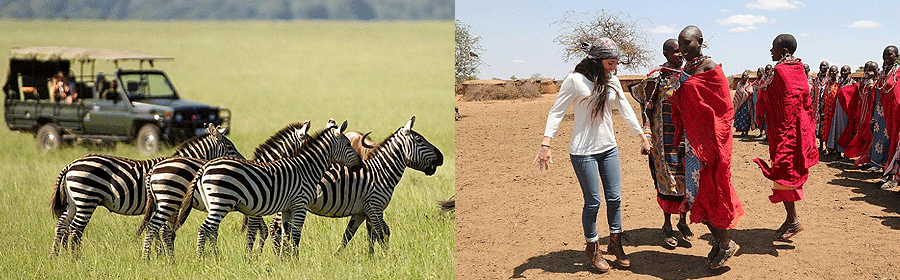
✓ Sunset Safaris: Late afternoon drives reveal Chyulu Hills at their most breathtaking. As the sun dips, the cloud cover often clears, revealing the snow-capped peak of Mount Kilimanjaro dominating the horizon.
The rolling volcanic hills glow in golden light, creating a stunning backdrop for photography. Guests can pause on high volcanic ridges or near the lava flows for sundowner drinks, watching as the sky turns from blue to fiery orange, with the silhouette of giraffes or elephants framing the iconic view of Africa’s highest mountain.
✓ Night Game Drives: In the private conservancies surrounding the park and specific areas, the wilderness comes alive after dark. Guided by spotlights, explore the nocturnal world where you might spot elusive creatures rarely seen during the day.
Look out for aardvarks, porcupines, civets, genets, and bushbabies leaping between the acacia trees. The cover of darkness also offers the best chance to see leopards on the prowl or listen to the distant roar of lions and the cackle of hyenas echoing against the volcanic cones.
✓ Morning & Afternoon Game Drives: Set out on guided 2–3 hour safaris across Chyulu’s dramatic volcanic landscape, characterized by emerald green hills, black lava flows, and ancient craters.
The park’s position between Tsavo and Amboseli creates a unique ecosystem where you can encounter massive “Super Tusker” elephants and large herds of buffalo moving through the mist-covered forests and open savannahs.
You may encounter majestic Eland (Africa’s largest antelope), Maasai giraffe, Burchell’s zebra, wildebeest, bushbuck, and mountain reedbuck. While predator densities are lower than in neighboring parks, Chyulu’s exclusivity offers intimate sightings of cheetahs, leopards, and occasionally lions and wild dogs, without the crowds.
The drives are accompanied by expert guides who navigate the rugged terrain and share insights into the volcanic geology and the behavior of the unique wildlife that inhabits this “Green Hills of Africa.”
Nature-Based Guided Walks
✓ Hiking & Walking Safaris: Chyulu Hills is a premier destination for hiking. Join armed KWS rangers and guides for treks up the volcanic cones or through the lush montane forests that cap the hills.
Unlike typical savannah walks, these hikes offer a chance to explore crater rims and mist forests, learning about the diverse flora, including wild orchids and medicinal trees like Sandalwood and Olea Africana.
The terrain varies from soft volcanic ash to rugged lava rock, offering hikers a physical connection to the land and panoramic views that stretch for miles over the Tsavo plains.
✓ Birdwatching: Chyulu is a haven for bird enthusiasts, boasting over 300 recorded species. The diverse habitats—ranging from open grasslands to dense cloud forests—attract a mix of savannah and forest birds.
Look for the striking Hartlaub’s Turaco, huge Silvery-cheeked Hornbills, Narina Trogons, and raptors like the Martial Eagle and Ayres’s Hawk-Eagle. The seasonal wetlands and nearby Lake Jipe also attract migratory species and waterbirds, making every walk a melodic discovery.
Immersive Conservation & Community Experiences
✓ Eco-Project Insights: Discover why Chyulu Hills is known as a critical water tower. Guests can learn how the porous volcanic rock acts as a giant sponge, feeding the famous Mzima Springs and sustaining wildlife far beyond the park’s borders.
Learn about the conservation efforts of organizations such as the Big Life Foundation and the Kenya Wildlife Service to protect this vital ecosystem from charcoal burning and poaching. Understanding the delicate balance of this water catchment area adds a profound layer of appreciation to your visit.
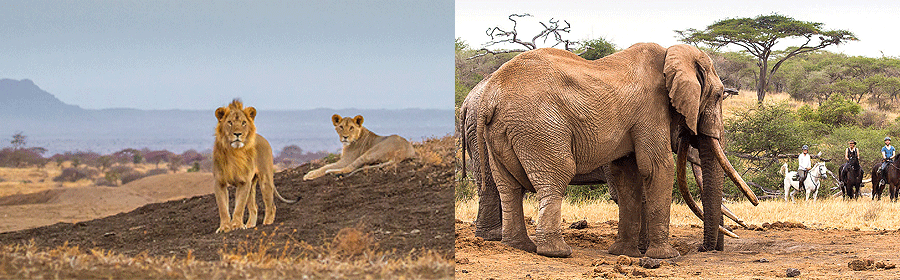
✓ Elephant Encounters: The Chyulu-Amboseli ecosystem is legendary for its elephants, particularly the “Big Tuskers”—elephants with tusks weighing over 100 pounds each. These giants often roam the corridors between the parks.
Witnessing these magnificent creatures in the dense bush or crossing the lava plains is an awe-inspiring experience. The area is also a research hub, and guides can often share stories about specific elephant families and their long histories in the region.
✓ Community Visits: Step into the culture of the local Maasai and Kamba communities living around the Chyulu Hills. Visit a traditional manyatta to experience their way of life, from beadwork and traditional songs to herding practices that have coexisted with wildlife for centuries.
These visits provide a genuine understanding of the human element of conservation and how local communities benefit from and protect the area’s wildlife heritage.
Unique Bush Experiences
✓ Stargazing: Far from light pollution, the night skies over Chyulu are dazzling. From your campsite or lodge, witness the Milky Way stretching across the horizon. On clear nights, the combination of the starry sky and the silhouette of the hills creates one of the purest stargazing experiences in East Africa.
✓ Mountain Biking: For the active traveler, the rugged volcanic terrain offers world-class mountain biking. Cycle along the ridgelines with Mount Kilimanjaro as your backdrop, navigating trails that wind through forests and open grasslands—a rare adrenaline-filled way to experience a national park.
✓ Horseback Safaris: Experience the thrill of a safari on horseback. Riding through the open plains and acacia woodlands allows you to get incredibly close to zebras, giraffes, and antelopes, as the animals view horses as fellow grazers rather than threats. It is a peaceful and exhilarating way to traverse the “Green Hills.”
✓ Cave Exploration (Spelunking): Unique to Chyulu is the Leviathan (Kisula) Cave, one of the longest lava tubes in the world (11.5 km). Adventurous guests can explore sections of these underground tunnels and witness bizarre lava formations and cone-shaped stalagmites. It is a journey into the earth’s fiery past that few other parks can offer.
Wildlife that can be viewed in Chyulu Hills National Park
Wildlife & Biodiversity
Chyulu Hills National Park is a critical conservation area within the greater Tsavo-Amboseli ecosystem, forming a vital wildlife corridor between Tsavo West National Park and Amboseli National Park.
Covering approximately 741 square kilometers of volcanic wilderness, Chyulu serves as a bridge, allowing wildlife to migrate freely between these two legendary reserves. The park’s landscape is a dramatic contrast of habitats—from the dense, mist-capped montane forests on the upper slopes to the rough grasslands and thickets of the lower volcanic plains.
This unique geology, characterized by porous volcanic ash and lava rock, allows the hills to function as a giant water tower. Rainfall is absorbed into the hills, feeding the Mzima Springs and the Tsavo and Galana rivers, which sustain wildlife populations far beyond the park’s borders.
Chyulu is often referred to as the “Green Hills of Africa,” a name immortalized by Ernest Hemingway. Its isolation and rugged terrain provide a refuge for species that prefer the cover of dense vegetation and rocky outcrops.
While wildlife densities are generally lower than in the open savannahs of Tsavo, the park offers exclusive sightings of forest-dwelling species and serves as a sanctuary for the critically endangered Eastern Black Rhino in the bordering conservancies.
Wildlife at Chyulu Hills National Park
Large Mammals
✓ Eland – Africa’s largest antelope thrives here, often seen in small herds grazing on the volcanic slopes
✓ Maasai Giraffes – Frequently spotted browsing on the acacia trees on the lower slopes and open plains
✓ Cape Buffalo – Large herds are commonly found in the dense forest belts and lower thickets, where they seek shade and water
✓ Plains Game – Burchell’s Zebra, Wildebeest, Steinbok, and Klipspringer are common residents of the grasslands and rocky outcrops
✓ Giant Forest Hog & Bush Pig – A rare treat for visitors, these elusive species inhabit the dense montane forests on the upper peaks
✓ Mountain Reedbuck & Bushbuck – These shy antelopes are adapted to the rugged terrain and are often spotted on the higher, grassy ridges
✓ Eastern Black Rhino – While rare within the open park, they are protected in the heavily guarded sanctuaries on the western slopes bordering the community ranches
✓ African Elephants – The park is a key corridor for massive “Super Tuskers” moving between Tsavo and Amboseli. These giants are often seen navigating the lava flows and thickets
Big Cats & Predators
✓ Cheetahs – Occasionally seen hunting on the open savannah plains on the lower slopes
✓ African Wild Dogs – Rare sightings occur as packs traverse the corridor in search of prey
✓ Spotted Hyenas – Common scavengers that can be heard calling through the hills at night
✓ Lions – While less common than in neighboring parks, resident prides roam the area, often following the movements of prey between ecosystems
✓ Leopards – The rocky outcrops, lava tubes, and dense forests make Chyulu prime leopard territory. They are frequently sighted using the terrain to ambush prey
Reptiles & Smaller Mammals
✓ Rock Hyrax – Commonly seen sunbathing on the ancient lava rocks
✓ Snakes – The rocky lava terrain is home to the Black Mamba, Puff Adder, and Rock Python
✓ Primates – Baboons and Sykes’ (Blue) Monkeys are often encountered near the forest edge and rocky ridges
✓ Chyulu Hills Blade-horned Chameleon – A recently rediscovered species endemic to these hills, making it a prize sighting for herpetologists
Birdlife
✓ Migratory Birds – From November to April, the park hosts Palearctic migrants, adding to the resident count of over 300 species
✓ Raptors – The hills are a haven for birds of prey, including the Martial Eagle, African Crowned Eagle, and Ayres’s Hawk-Eagle
✓ Endemics & Near-Endemics – Look out for the Shelley’s Francolin and the Abbott’s Starling, which move between Chyulu and Mt. Kilimanjaro
✓ Forest Specialists – The montane forests host unique species like the Hartlaub’s Turaco, Narina Trogon, White-starred Robin, and Orange Ground Thrush
Where To Stay In Chyulu Hills National Park | Hotels Camps & Lodges
While there is no accommodation within the park numerous accommodation options exist in nearby Tsavo West National Park and two very exclusive lodges offering a full range of activities in Maasai concessions on the foothills of the Chyulu Hills. Lodge options include Ol Donyo lodge and Campi Ya Kanzi.
Others include Maasai Simba Camp, Hunters Lodge, Kibo Safari Camp, Elerai Camp, Amboseli Eco Camp, Hunters Lodge, Umani Springs Camp, The W Hotel Kimana, Kilaguni Serena Safari Lodge, and Kimana Omega Safari Lodge among others.
Chyulu Hills National Park Kenya has three public campsites. The campsite at Kithasyo Park offers basic amenities. There is Kenya Wildlife Service self-catering guest house outside boundaries located just off the Nairobi – Mombasa road near Kiboko. The guest house is 59 km from Kithasyo Gate and Park headquarters.
Chyulu Hills National Park Climate & Best Time to Visit
The Summertime: October – April) Minimum 20°C/ 68°F Maximum 34°C/94°F. The Wintertime: May – September) Minimum 11°C/52°F Maximum 25°C/78°F. The long rains from April to May; short rains from November to mid-December.
Chyulu Hills can be visited year-round, but wildlife viewing is usually best in the dry months from June to October and January to February.
Chyulu Hills National Park Tsavo & Amboseli Kenya Information
Chyulu Hills National Park is located in Makueni County in the South Eastern region of Kenya and lies between the Tsavo and Amboseli ecosystems. The park is 30 km southwest of Kibwezi and approximately 190 km southeast of Nairobi.
The Chyulu Hills National Park (meaning “The Spotted Hills”) protects a volcanic mountain range that runs parallel to the highway between Mombasa and Tsavo, near Kibwezi. With distinctive, rounded hills and volcanic vents that have solidified black lava flows running down at irregular intervals, the Chyulu Hills are definitely unusual.
The Park offers one of the best places to view Africa’s highest mountain Kilimanjaro, (75km to the northeast of Mount Kilimanjaro) it’s also the largest larva in the world. The mountain ranges up to 2188 meters, and its highest peak is 150 km long. Chyulu Hills National Park was established in 1983 and forms the northwestern continuation of Tsavo West National Park.
Volcanism in the area began about 1.4 million years ago in the northern parts of the hills, and over time, it propagated toward the southeast. These volcanoes are still considered active, though their last two eruptions (Shaitani and Chainu) occurred in 1856. In the hills lies Leviathan Cave, one of the longest lava tubes in the world.
The Chyulu Hills do not have any permanent rivers, but rainfall on the hills feeds the Tsavo and Galana rivers and the Mzima Springs on the surrounding plains, thanks to the hills’ porous volcanic ash peaks, which trap moisture-laden winds.
Chyulu Hills National Park is part of the Tsavo Conservation Area, which includes Tsavo West National Park, Tsavo East National Park, and the Kibwezi Forest. The park’s main gate is in Kibwezi in Makueni County. The area where the Chyulu Hills are found is inhabited by the Maasai and Kamba people, whom tourists can enjoy during cultural encounters.
Chyulu hills national park is dominated by various species of vegetation in different regions of the park, the lower slopes of the hills are dominated by grasslands and thickets. The top of the hills at an elevation of 1800 meters is dominated by montane forests consisting of tree species such as cassipourea malonsana, Olea capensis, Prunus Africana, Tabernaemontana stapfiana, neoboutonia macrocalyx, Llex mitis, and many more.
The lower forest galleries consist of Juniperus procera, and the park’s plains are dominated by savannah vegetation and thickets. The hills are home to a variety of animals, including eastern black rhinos, Cape buffaloes, bushbucks, elands, buffalo, elephants, bush pigs, Masai giraffe, leopards, lions, mountain reedbucks, steinbok, wildebeests, and Grant’s zebras. Giraffe, the rare fringe-eared oryx, and the gerenuk are also present.
Cheetahs are found on the plains of the Chyulu Hills, and various snakes inhabit the hills, including black mambas, puff adders, and rock pythons. There are numerous bird species living on the hills, including some endemic races, making it an important birding destination.
Bird species include: Shelley’s francolin, white-starred robin, orange ground thrush, cinnamon bracken warbler, Ayres’s hawk-eagle, African crowned eagle, martial eagle, and Abbott’s starling
Activities in Chyulu Hills National Park, Tsavo & Amboseli, Kenya include walking safaris, mountain biking, mountain climbing, bird watching, day & night game viewing, horse riding, and camping. Species seen around the Chyulu Hills might not be seen so easily in Amboseli, as there are no night drives, including leopard, porcupine, and aardvark.
Booking & Reservations Chyulu Hills National Park Tsavo & Amboseli Kenya Contact
Mobile: + 254-721-242-711
WhatsApp: +254-721-242-711
Reservations: +254 718-179-967
Email: [email protected]
Website: https://africanspicesafaris.com