
Meru National Park
Meru National Park is a complete wilderness and one of Kenya’s most beautiful and geographically diverse wildlife havens. Occupying 870 sq km (87,000 hectares) in Kenya’s Eastern Province, the park rests on the eastern slopes of the Nyambene Hills and offers distant views of snow-capped Mount Kenya.
Straddling the equator, the park is a striking contrast to Kenya’s dry savannahs. It is bisected by 13 rivers and numerous mountain-fed streams that flow into the Tana River—Kenya’s longest river, which forms the park’s southern boundary. Dense riverine forests of Doum and Raffia palms fringe these waters, creating a lush, green paradise.
The park’s history is a story of tragedy and triumph. It gained international fame in the 1960s through the story of George and Joy Adamson and their hand-raised lioness, Elsa, as told in the book and film Born Free.
After a devastating period of poaching in the 1980s, concerted conservation efforts by the KWS, the French Development Agency, and IFAW successfully restored Meru to its former glory, making it a premier, off-the-beaten-path safari destination.
Location & Accessibility
The park is located in central Kenya, approximately 348 km northeast of Nairobi and 85 km east of Meru town.
By Road:
✓ Park Gates: Murera, Bisanadi, Ura, and Kinna
✓ Route 1 (Via Nanyuki): From Nairobi (348 km), drive via Nyeri – Nanyuki – Meru – Mau – Murera Gate on an all-weather road. The drive typically takes 5 to 6 hours
✓ Route 2 (Via Embu): From Nairobi (348 km), drive via Embu – Meru – Mau – Murera Gate on all-weather roads. The park entrance is just before Mau town
✓ Route 3 (Via Ura Gate): Access via Embu to Ura Gate, covering approximately 290 km from Nairobi
By Air:
✓ Flights: Daily scheduled flights depart from Nairobi’s Wilson Airport (WIL) directly into the park.
✓ Airstrips: The park has 16 airstrips in total, with 5 primarily used for visitor access: Kinna, Mulika (next to Meru Mulika Lodge), Elsa’s Kopje, Masanduku, and Murera. (Mughwango is a private airstrip just a 5-minute drive from Elsa’s Kopje lodge).
Wildlife & The Rhino Sanctuary
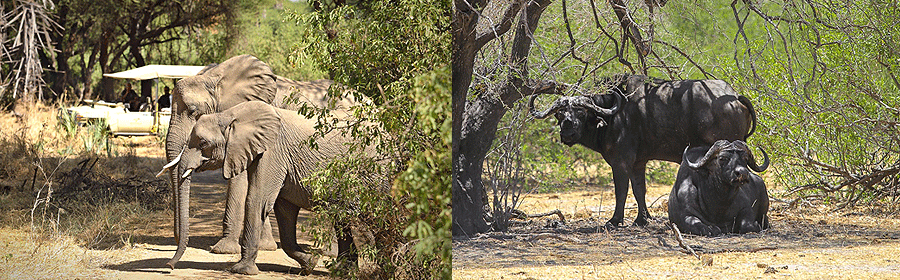
Game viewing in Meru is excellent, featuring four of the “Big Five” (elephants, lions, leopards, and rhinos) against a backdrop of unspoiled wilderness.
The Rhino Sanctuary
One of Meru’s biggest draws is its highly successful, heavily guarded Rhino Sanctuary.
✓ Size & Location: Covers a substantial 80 sq km near the western boundary (Murera Gate).
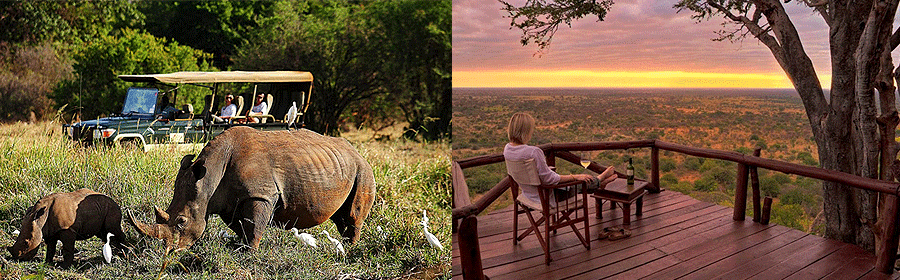
✓ Sightings: Home to both endangered Black and White Rhinos. Because they are monitored around the clock, the rhinos are well-habituated, offering excellent, close-range photographic opportunities.
Predators, Herbivores & Aquatic Life
✓ Mammals: Large herds of buffalo, elephants, lions, cheetahs, and leopards
✓ Aquatic Life: The park’s 14 permanent rivers and swamps are teeming with hippos and large crocodiles
✓ Rare Northern Species: Endangered Grevy’s zebra, reticulated giraffes, Lesser Kudu, eland, Oryx, duiker, and Dik Dik
Birdlife
✓ Species: Over 300 species of birds have been recorded.
✓ Viewing: Best undertaken at dawn or dusk along the riverbanks and swamps where diverse aquatic and savannah species congregate.
Key Landmarks & Viewpoints
✓ Elsa’s Grave: Pay your respects at the final resting place of Elsa the lioness, who died in 1961
✓ Pippa’s Grave: The burial site of Joy Adamson’s beloved cheetah, Pippa (died 1969), where Joy’s ashes were also scattered
✓ The Swamps: Mughwango, Mulika, Bwatherongi, Mururi, and Leopard Rock swamps are vital water sources where animals congregate heavily during the dry season
✓ Adamson Falls: A spectacular 50-meter waterfall where the Tana River forces its way through a narrow rock valley. The hike takes 2 to 3 hours, depending on fitness levels
Activities
✓ Bush Walks: Sedate walking safaris and nature walks to take in the scenery
✓ Fishing: Catch Barbus and catfish along the Tana River and at designated campsites
✓ Picnics & Sundowners: Organized through local lodges in scenic spots across the park
✓ Game Drives & Scenic Safaris: Explore the dense vegetation, riverine forests, and open savannahs with uninterrupted views of Mt. Kenya
✓ Cultural Visits: Interact with the local Meru, Kamba, Borana, and Orma pastoralist communities at the Meru Cultural Center (outside Murera Gate) or Malka Cultural Center (outside Bisanadi Gate)
Climate & Best Time to Visit
✓ Climate: Due to its equatorial position, daytime temperatures are usually hot and dry, varying very little throughout the year.
✓ Best Time: The long dry season from June until September offers the most rewarding wildlife viewing, as animals gather around permanent water sources.
✓ Rainy Seasons: Long grasses during the long rains (March to May) and short rains (October and November) make spotting wildlife harder, and elephants often migrate north out of the park.
Accommodation
Luxury Lodges & Camps:
✓ Elsa’s Kopje Lodge
✓ Rhino River Camp
✓ Meru Mulika Lodge
✓ Leopard Rock Lodge
Mid-Range (Outside the Park):
✓ Ikweta Safari Camp
✓ Murera River Camp
Budget (KWS Self-Catering Bandas):
✓ Kinna Bandas
✓ Bwatherongi Bandas (Features a public campsite with showers)
Camping:
✓ Special Campsites: Kampi Baridi, Kitanga, Makutano, Rojoweru, Mugunga, Ken Mare, and Kanjoo. These require prior booking and have no facilities.
Meru National Park Entrance Fees
2026 Meru National Park Entrance Fees
|
East African Citizen |
Kenyan Resident |
Non-Resident |
African Citizen |
||||
|
Adult |
Child/ |
Adult |
Child/ |
Adult |
Child/ |
Adult |
Child/ |
|
800 |
500 |
1,100 |
675 |
70 |
40 |
40 |
20 |
Notes:
* Child refers to persons from three years but below 11 years
* Resident refers to persons of other nationalities residing in Kenya with valid documentation from the Kenyan government
* Citizen – A native or inhabitant of East African countries (Kenya, Uganda, Tanzania, Rwanda, Burundi, and South Sudan) with valid identification documents or a passport
* Daily – Fee paid for a single entry to a national park, national reserve, or sanctuary, and which shall be valid for no longer than twenty-four hours
Meru National Park Wildlife | Animals & Bird
Wildlife & The Rhino Sanctuary
Meru National Park is celebrated for its untamed natural beauty, featuring a diverse landscape of forests, mountains, rivers, and swamps. It is a premier wildlife destination where visitors can spot all members of the famous “Big Five”: the African bush elephant, African leopard, lion, buffalo, and both black and white rhinos.
The Meru Rhino Sanctuary
One of the park’s biggest draws is its highly successful rhino sanctuary.
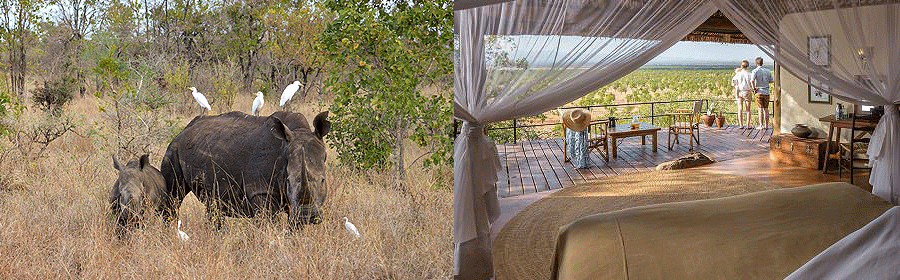
✓ Populations: The sanctuary is home to roughly 40 white rhinos that are thriving, and around 20 eastern black rhinos (who tend to face challenges with tsetse flies).
✓ Size & Location: Covering a substantial 84km² (8,400 hectares) beside the western boundary near the main gate. It is perfectly sized to ensure eager tourists still have to work for their sightings, maintaining a truly wild experience.
✓ Viewing: Protected by fencing that allows free movement for smaller animals and guarded by numerous rangers, the rhinos are monitored around the clock. They are well-habituated to visitors, offering excellent, close-range photographic opportunities.
Predators & Herbivores
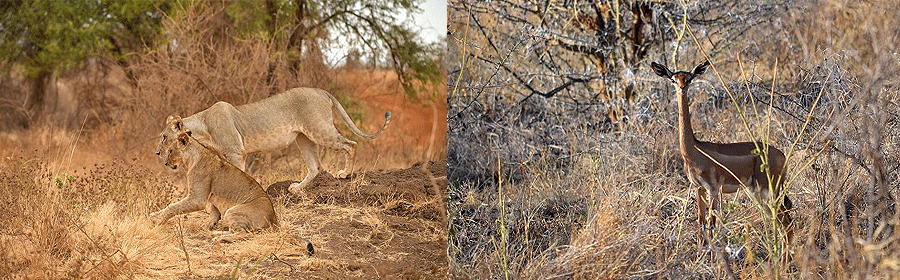
✓ Predators: The park is home to big herds of lions, African leopards, cheetahs, and elusive wild dogs.
✓ Rare Northern Herbivores: Spot the endangered reticulated giraffe and Grevy’s zebra, alongside the common zebra, Beisa oryx, gerenuk, and the Somali ostrich.
✓ Aquatic Life: The park’s numerous rivers and swamps are teeming with large crocodiles and hippos, while the Tana River offers excellent fishing for Barbus and catfish.
✓ Antelopes & Gazelles: A wide variety, including greater and lesser kudu, Bohor reedbucks, eland, Grant’s gazelles (though not Thomson’s), impalas, and both Günther’s and Kirk’s dik-diks.
Birdlife: A World-Class Spectacle
With over 400 species recorded, Meru National Park is a birder’s paradise featuring everything from wetland birds to grass and woodland specials.
✓ Notable Specials: Red-necked falcons, three-banded coursers, Somali bee-eaters, golden palm weavers, Boran cisticolas, and black-billed wood hoopoes.
✓ Unique Biomes: Meru boasts one of the eight species of the Kenya Mountains Endemic Bird Area and an impressive 59 of the 94 Somali-Masai biome species found in Kenya.
✓ Rare & Threatened Species: Recent sightings of the threatened Hinde’s babbler have had birders aflutter. The threatened Jungle Babbler (which has a very restricted range in central Kenya) has also been documented near Kindani and Nyati Camps. Regionally threatened species include the Martial Eagle, Grant’s Woodhoopoe, and the Saddle-billed Stork, which is known to breed in this area.
Key Landmarks & Viewpoints
✓ Pippa’s Grave: Visit the burial site of Pippa the cheetah, another beloved animal brought up by Joy Adamson. Pippa lived from 1964 to October 1969, and Joy’s ashes were later scattered over her grave
✓ Meru Rhino Sanctuary: A secure 80km² area beside the western boundary near the main gate. The sanctuary guarantees excellent, close-range sightings of well-habituated black and white rhinos monitored around the clock
✓ Adamson Falls: A spectacular 50-meter high waterfall where the Tana River is forced through a narrow rock valley. Named after the pioneering conservationists who first settled in the park, the falls can be reached via a rewarding 2 to 3-hour hike, depending on physical ability
✓ Elsa’s Grave: Pay your respects at the final resting place of Elsa, the beloved lioness made famous by Joy Adamson’s best-selling book and the award-winning movie Born Free. Raised by game warden George Adamson and his wife Joy, Elsa lived from January 1956 to January 1961
✓ The Swamps & Rivers: The park is a watery oasis featuring 14 permanent rivers (including the Murera, Rojowero, Kiolu, Ura, Bwatherongi, and the Tana River) and numerous swamps like Mughwango, Mulika, Bwatherongi, Mururi, and Leopard Rock. These are prime viewing spots where animals congregate heavily during the dry season
Activities & Experiences
✓ Fishing: Cast a line for Barbus and catfish, which is permitted at designated campsites and along the banks of the Tana River
✓ Nature Walks & Bush Walks: Enjoy sedate walking safaris that offer the perfect opportunity to take in the breathtaking scenery at a slower, more intimate pace
✓ Camping, Picnics & Sundowners: Spend a night in the wild at one of the several campsites within the park, or enjoy scenic picnics and sundowners organized by local hotels
✓ Bird Watching: With over 300 species of birds recorded (including over 400 noted in wider surveys), bird watching is highly rewarding, especially when undertaken at dawn or dusk
✓ Game Viewing & Scenic Safaris: Enjoy excellent game drives through diverse landscapes—dense riverine forests, swamps, and long-grass savannahs—with uninterrupted views of Mt. Kenya. Spot four of the Big Five alongside rare northern species, hippos, and crocodiles
✓ Community & Cultural Visits: Meet the local communities whose sacrifices made the park possible. Visit the Meru cultural center outside Murera Gate or the Malka (Boran) cultural center outside Bisanadi Gate. Learn about the rich conservation traditions of the neighboring Meru, Kamba, Borana, and Orma pastoralists
Meru National Park Accommodation
Accommodation
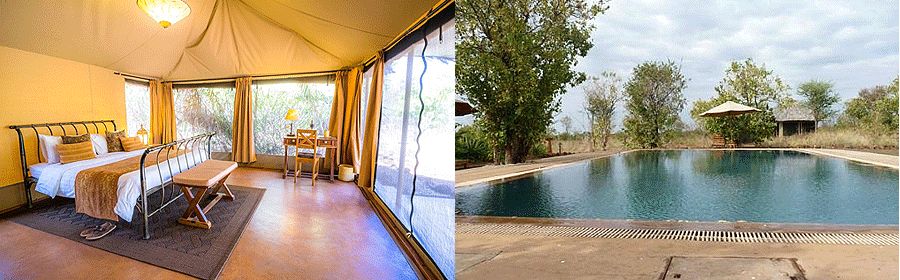
Accommodations in and around Meru National Park cater to diverse needs, ranging from world-class luxury lodges and mid-range tented camps to basic Kenya Wildlife Service (KWS) bandas and campsites.
Mid-Range Camps (Located Outside the Park):
✓ Ikweta Safari Camp
✓ Murera River Camp
Budget & KWS Self-Catering (Inside the Park):
✓ Kinna Bandas
✓ Murera Bandas
✓ Bwatherongi Bandas
Luxury Lodges & Camps (Inside the Park):
✓ Rhino River Camp
✓ Elsa’s Kopje Lodge
✓ Meru Mulika Lodge
✓ Leopard Rock Lodge
Campsites / Camping:
✓ Public Campsites: Available at Bwatherongi Bandas (equipped with showers).
✓ Special Campsites: Kampi Baridi, Kitanga, Makutano, Rojoweru, Mugunga, Ken Mare, and Kanjoo. (These require prior booking and have no facilities.
Accommodation in Meru Town (85 km from Murera Gate):
✓ For visitors who prefer to base themselves in a small agricultural town on the slopes of Mt. Kenya, there are numerous hotel options. These include Alba Hotel, Meru Three Steers, Meru Slopes Hotel, Meru Elsa Hotel, Pig & Whistle Hotel, Blue Towers, Gatimene Palm Springs, Nevada Palace Hotel, White Star Hotel, Hotel Royal Prince, and Brown Rock Hotel.
Places of interest within Meru Town
Meru town is an agricultural centre. Tourism is not prevalent, thus if you desire a hassle-free, cool place, you can use it as a base to explore the slopes of Mt. Kenya and Laikipia. The town is surrounded by agricultural farmlands. Wheat and horticulture plantations occupy the Timau region adjacent to Lewa Conservancy.
An interested visitor with intentions to mingle with the locals can sample the following:-
✓ Rukunga’s private museum. Visit the King Muhuru
✓ Lake Nkunga picnic site can be visited with an arrangement
✓ Swimming is available at the Golf Club, Fred’s Academy, and Thiiri Center. The pool at the Golf Club is good, but it’s rarely used
✓ The Njuri Ncheke (Council of Elders) headquarters at Nciru to learn how justice was dispensed among the locals in the old days
✓ The Gakoromone open-air market is for stocking up and chatting with the locals. Just carry loose change to use at the market, and be careful of pickpockets
✓ Bisanadi National Reserve: To the east of the park lies Bisanadi National Reserve. It is located on the border between the Meru and Borana peoples. Opened in 1979, it covers an area of 606 km². It is accessible by 4WD vehicles and is ideal for camping. There is an airstrip at Korbessa
✓ Meru Museum: Formerly, a District Commissioner’s Office was built in 1916. The Museum is ethnographic, exhibiting the Culture of the local people. On display are various tools, artifacts, local geology, stuffed mammals, and birds. Besides, the museum has a traditional homestead, a crocodile and snake pit, and various herbs
✓ Kora National Park: Across the Tana River, covering an area of 1,787 square kilometers. It is in the Kora National Park that George Adamson was murdered in his camp. Kora is full of Inselbergs, rocky outcrops covered with vegetation that seem to appear randomly above the plains.
Mammal life includes elephants, Lesser Kudu, wild dogs, striped and spotted hyenas, leopards, and cheetahs. 21 species of fish have been recorded, with 500 species of insect, 33 molluscs, and 40 reptiles.
Meru National Park Information
Meru National Park occupies 870km² (870,000 hectares) of central Kenya, some 220 miles/ 300 km northeast of Nairobi, and offers views of snow-capped Mount Kenya on the distant western horizon.
The Park lies at an altitude of between 1,000 and 3,400 Ft above sea level and is located in Meru Country in Kenya’s Eastern Province, below the eastern slopes of Nyambene Hills.
Meru National Park lies 85 km east of Meru town. It is managed by the Kenya Wildlife Service on behalf of the Central Government. The park is also called Elsa’s Country and is described as a “complete wilderness,” a beautiful paradise that has attracted visitors from all corners of the globe.
The park forms a vital part of the much larger Meru Conservation Area, which centres on the Tana River system and protects nearly 5,000 km² (five million hectares). Meru covers habitats that range from lush green vegetation on rich volcanic soils to semi-arid scrublands and open plains. The park also offers dense riverine forests of Doum and Raffia palm.
In addition to the Meru National Park, the complex of protected areas includes Bisanadi, Rahole, and Mwingi (formerly Kitui North) National Reserves and the massive Kora National Park. The result is one of Kenya’s most extensive protected spaces, second only to the Tsavo ecosystem in size.
| Meru National Park | 807km2 (87,000 hectares) |
| Kora National Park | 1,787km2 (178,700 hectares) |
| Bisanadi National Reserve | 606km2 (60,600 hectares) |
| Mwingi National Reserve | 745 km2 (74,500 hectares) |
| Rahole National Reserve | 870km2 (87,000 hectares) |
Straddling the equator, Meru National Park is bisected by 13 rivers and numerous mountain-fed streams, making it a green paradise compared to Kenya’s dry savannah. The many permanent rivers that flow through Meru, including the major Rojerwero and Ura Rivers, are part of the Tana River basin and define the park’s landscape.
The Tana River, which marks Meru National Park’s southern boundary, is Kenya’s longest river, flowing from the Aberdare Mountain Range and fed by springs from Mount Kenya, before winding a sinuous path to the Indian Ocean.
These waterways are fed by springs in the Nyambeni Mountains and flow in parallel, creating the impression that the park is made up of a series of islands. Beneath a thick fringe of riverine forest, hippos and crocodiles lurk in the dark waters.
Like many of Africa’s protected areas, Meru’s story is one of triumphs and tragedies. The park gained international renown during the 1960s when the adventures of George and Joy Adamson and their hand-raised lioness Elsa made first literary and then cinematic history.
The Adamsons raised Elsa from a cub, and Joy documented their experiences in a series of novels, the Born Free series. Elsa was eventually released into Meru National Park to live wild, and her final resting place is marked by a small gravesite on the park’s southern boundary. The park’s popularity skyrocketed when the eponymous film was produced, and visitors flocked to explore the famous setting.
Tragedy struck during the 1980s as poaching and unrest tore through much of Kenya. Both Joy and George were murdered in separate incidents, and the region’s wildlife was decimated. The park fell into disrepair, and the flood of tourists slowed to a trickle before drying up almost entirely.
Hope came some 20 years later when concerted conservation work by the Kenyan Wildlife Service, the French Development Agency, and the International Fund for Animal Welfare set in motion the painstaking process of returning the park to its former glory.
The infrastructure was repaired with a substantial cash donation, and security and anti-poaching measures were implemented.
Booking & Reservations Meru National Park Contact
Mobile: + 254-721-242-711
WhatsApp: +254-721-242-711
Reservations: +254 718-179-967
Email: [email protected]
Website: https://africanspicesafaris.com